




|
| So how long do you leave the wooden skewer in the pot to determine if that plant needs water? Do you push it in and then pull out? Leave in for 5 minutes? Leave it there all the time and pull out to look?
Jerry |
Follow-Up Postings:
|
| Just a quick in and out is all you need. If the wood is damp, it will feel cool. Often, if it's wet, there will be soil particles clinging to the skewer. AL |
|
- Posted by jojosplants Az. z. 9 (My Page) on Tue, May 3, 11 at 17:10
| Hi Jerry, I do as Al said.. and take that few minutes to look my plants over and enjoy them. :-) JoJo |
|
- Posted by meyermike_1micha 5 (mikerno_1@yahoo.com) on Tue, May 3, 11 at 17:14
| Hi Jerry, I do as Al said too and it has been a God send:-) Mike |
|
- Posted by JerryVentura 10 (My Page) on Tue, May 3, 11 at 18:52
| Thank you all, I went around checking, and the plants look good but it's probably a good thing I've still been watering twice a day. It's 3:45 here and I stuck the skewer down about 7 inches, an inch of the tip was wet. Until now I've just been guessing. Jerry |
|
| Some people place the skewers in and leave them there, pulling them out to check for moisture, and others do as mentioned above... push them in, then pull them out, without leaving them in. The nice thing is, you can get a 100 pack of them for about a dollar at any grocery store. The important thing is to angle them toward the center of the root/soil ball when inserting them, so you get an accurate reading of whether any moisture is really available for the roots, or not. Some people's fingers might not be sensitive to the moisture or temperature of the skewer when it's pulled out, but if you gently press it against your cheek, you should be able to feel if it's cool and moist to the touch. Warm and dry would indicate a need to water... and cool and moist would indicate that's there's still moisture available at the root zone. For larger pots, you can use wooden dowels of any length, most likely available at any hardware store. |
|
| Jerry, I'm so glad you asked this question. Not understanding, I had been leaving the skewer in the medium between waterings and found mold on the it at the soil level - not desirable. I found it works much better for me to let it sit a few minutes and then check. This is a great technique. |
|
- Posted by TheMasterGardener1 none (My Page) on Tue, May 3, 11 at 20:33
| How big are your pots? To tell when plants need water give the pot a spin or lift it up. If it is "paper light" then time to water if there is alot of weight then let them go. |
|
- Posted by jojosplants Az. z. 9 (My Page) on Tue, May 3, 11 at 20:44
| I have some that are 14" and up. Don't care to be lifting them. Skewer works perfect. JJ |
|
- Posted by JerryVentura 10 (My Page) on Tue, May 3, 11 at 20:51
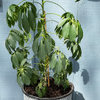
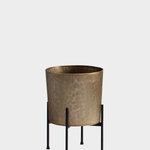
| Most of my pots are fairly large, this is one of the medium ones. I don't think I'll be lifting any of them :-) |
|
- Posted by jojosplants Az. z. 9 (My Page) on Tue, May 3, 11 at 21:06
| LOL! Nope that's a good size one! I wouldn't either. ;-) That's a great looking container Jerry. What is it made out of? A lot of mine are terra cotta and very large! Plus in my plant room when they are all packed on a shelf I run the risk of bumping and breaking plants if i'm lifting pots. Some of my plants I know need watered just from learning their ways. The rest, the skewer is the best and easiest way to tell. Jodi pointed out fingers are not always the best way to tell and a great point it is! They become calloused. The cheek works well, or the inside of the wrist. Moms have used that for ages to test a baby's bottle. ;-) JoJo |
|
| I have been also dipping the wooden skewer in, letting it sit for about 1 minute, then pulling out. It's pretty obvious when you still have moisture, because like Al said, it will have particles on it, but also, it will have a dark tone to it, from the wet turface. However, I have a couple of concerns with this method, the first being the possibility of damaging roots when you keep prodding the soil. This is the reason I don't go for the middle, but stay towards the outside. Also, I worry that if you keep mashing the soil, that over time you will break up too much of the ideal sized particles into smaller particles. Maybe I'm being my usual self again, and examining EVERY aspect of what I do, and what will or could happen. Oh, hey, JoJo, what's this about "Moms using the cheeks or wrists"....... what about us Dads?!? I've done it many of times, and it works good for testing out the temperature of bath water too, which in fact, I just did about 2 hours ago when I gave my youngest munchkin a bath. Then, she (my 3 year old daughter) proceeded to help me pot up my new portulacaria afras in some gritty mix! She asked so many questions about it, that I felt like Al answering us! She'll ask again tomorrow though...... Joe |
|
- Posted by meyermike_1micha 5 (mikerno_1@yahoo.com) on Tue, May 3, 11 at 21:27
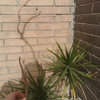
| Hey Jojo They do make square Terra coot pots. Here is one in which I have no idea of which plant I have feels deserves to go into it. They do with a ton though.lol I would much rather use the wooden dowel method than lift these things up. Anyway, how can anyone get an accurate reading of moisture in their mix when pots like these weigh a ton anyway? Mike |
|
- Posted by TheMasterGardener1 none (My Page) on Wed, May 4, 11 at 0:08
| Yup. If you have light plastic pots they are easy to move. That is a very nice planter! You could get a moisture reader. |
|
- Posted by greenman28 NorCal 7b/8a (My Page) on Wed, May 4, 11 at 0:26
| Master Gardener, the skewer method is recommended for mixes composed of larger particulate. Moisture meters that register electrical conductivity aren't effective with a course-textured mix. On-Topic: I do both - leave in, and use as needed.
Josh |
|
| Lifting pots to determine weight, as a method of telling when it's time to water, is only useful if you can actually lift the pot. There are other variables that can interfere, as well. Not all pots, plants, or mediums are of equal weight, and there's really no accurate way to measure moisture content within the root/soil ball using this method. Just because a pot weighs less today than it did yesterday does not mean it needs more moisture added... some soils will retain moisture at the very center and still feel light when we lift that pot. Using a finger to test for moisture is not accurate, either. Human fingers are not long enough to reach down into the center of most pots, therefore, we cannot actually determine how much moisture by touch the lower portion of the soil ball contains. Just because the top couple of inches are dry to the touch, does not mean the rest of the root/soil ball is dry. The human sense of touch doesn't usually detect any moisture in vapor form, either... so there's a good possibility that there's still moisture left when many people think they feel dry medium. In my own experience, moisture meters aren't very accurate, either. They detect water by measuring electrical conductivity, or something to that effect... I'm not an expert on electricity... but I have found that most meters on the market are way less than accurate. (Perhaps someone with more knowledge can explain moisture meters and how they work.) Wooden skewers are, to date, the most accurate method I've found for testing moisture levels within the root/soil ball of my containerized plantings. It works every time!
|
|
- Posted by jojosplants Az. z. 9 (My Page) on Sun, May 8, 11 at 14:44
| Hi Joe! I guess you got me on that one! LOL! Yes, I should have given fathers credit too! ;-) So A Happy Mother's day to you, and all the other dad's out there that help with the munchkins! ;-) JoJo |
|
| The moisture meters are affected by ferts in the soil (back to EC topic). But in general with plants in typical bagged based soil I've found they work "OK" if you have nothing else. IMO for beginners with fresh plants, they are an important first step. However, IME the meters become completely unreliable when the rootage starts to occupy the majority of the container root zone. As the media to root ratio is reduced and the soil is replaced by so much fine rootage, they start acting real weird shooting around wildly. And yeah, the meters don't work for the gritty mix; it's like you're measuring air space. I've struggled a bit with wooden skewers as I seem to be tearing fine rootage a lot. I can feel the roots tearing, sometimes on the "way back". Especially so if I happen to only have bamboo skewers to use (they start 'slivering' and catching the roots on the way up). But sometimes I can't tell if I'm hitting a piece of bark on the way down (and should just wiggle or push harder) or if it's really a thicker portion of root that I'm now digging into. I still frequently use the skewer method for my gritty mix containers but I certainly haven't found it easy every time I use them. Anyway, just my experience maybe you can offer me some better guidance. |
|
- Posted by TheMasterGardener1 none (My Page) on Mon, May 9, 11 at 0:13
| No you wont damage roots. If anything you are helping them. |
Please Note: Only registered members are able to post messages to this forum. If you are a member, please log in. If you aren't yet a member, join now!
Return to the Container Gardening Forum
Instructions
- You must be a registered member and logged in to post messages on our forums.
- Posting is a two-step process. Once you have composed your message, you will be taken to the preview page. You will then have a chance to review the contents and make changes.
- After posting your message, you may need to refresh the forum page in order to see it.
- It is illegal to post copyrighted material without the owner's consent.
- HTML codes are allowed in the message field only.
- No advertising is allowed in any of the forums.
- If you would like to practice posting or uploading photos, please visit our Test forum.
- If you need assistance, please Contact Us and we will be happy to help.