





Help my dull/poorly planned front yard!
After receiving tons of advice on this forum and creating an evolving backyard plan, I've come to realize that our front yard is in just as bad shape as our back is! The trees we currently have planted were poorly planned and now many need to be moved. I am hoping I can get some help making my front yard look as good as the backyard plans are. Below are a couple of pictures to illustrate our current situation:
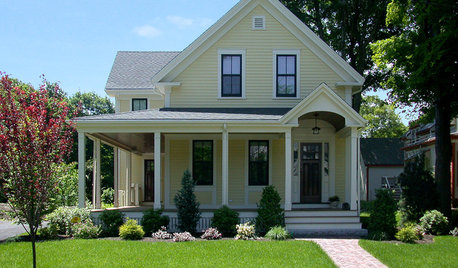
Front yard from street:
{{gwi:12351}}
Slightly closer view from the steet (tree in middle of front yard is a weeping cherry and parkway tree is a burr oak):
{{gwi:12352}}
Front of house (bed on left contains two knockout rose bushes; bed on right contains three yews, two small bushes with dark red leaves and thorns, and a redbud tree which probably need to be moved)
{{gwi:12354}}
Front right bed again and side bed containing knockout rose bushes:
{{gwi:12355}}
Left side of driveway. Balsam tree probably needs to be moved as it is too close to driveway (7'). Lot line runs back to fence. House next door is corner house so their back faces our side (no trees in their backyard)
{{gwi:12357}}
Thanks everyone for your help! This site has been incredible and I plan on creating a new thread on all that I leaned when these projects are finished!
Comments (85)

midwestguy33
Original Author12 years agolast modified: 9 years agoThanks! I was able to create some shape to the redbud by staking it (I will post pictures this weekend). I plan on moving the balsam on the left side this weekend. If I move one of the yews from the right bed (far right one) to the left bed, do I need to also move the two remaining yews on the right bed to be better spaced (one under each window)? Is there a location in the front yard where I could move the two knockout rose bushes that are in the left bed (we like the color they create during summer)? Any ideas on what we can plant in front of the yews? We're still stuck on what to plant along both sides of the house. I'm afraid that whatever we plant will grow to be too big to allow a path on each side (only 10' on left side and 16' on right).
 PRO
PROYardvaark
12 years agolast modified: 9 years agoYou're sounding a little braver about moving plants. After relocating one yew, I'd adjust the two remaining. You'll probably want to keep them trimmed low so as not to cover up stone at front of house. This will force them sideways faster. What about soapwort (Saponaria ocymoides) in front of yews. Consider a solid circular bed of stella de Oro daylilies around the redbud... about 15 plants to start.
On the right side of the house, Japanese tree lilac would work well. Or maybe a matched set of larger viburnums. On left side, not so big of viburnums or regular lilacs. Or compact Burning Bush grown in the tree form are some possibilities (all matched sets, of course.) I don't know where to suggest for moving roses. You might leave until later when some spot calls out to you.
Related Professionals
Oconomowoc Landscape Architects & Landscape Designers · Brookside Landscape Contractors · Arlington Landscape Contractors · Bell Gardens Landscape Contractors · College Park Landscape Contractors · Desert Hot Springs Landscape Contractors · Kettering Landscape Contractors · North Plainfield Landscape Contractors · Sun City Center Landscape Contractors · Waltham Landscape Contractors · Wentzville Landscape Contractors · Sugar Land Decks, Patios & Outdoor Enclosures · Jericho Stone, Pavers & Concrete · Las Vegas Swimming Pool Builders · Stafford Swimming Pool Buildersmidwestguy33
Original Author11 years agolast modified: 9 years agoI know this is an old post but I will be implementing some of the suggestions this spring and have a few follow-up questions:
1. Right now I am planning Nannyberry (viburnum) on one of the sides of the house (group of three). Which side would be better for these (left side is north.....so shady, and narrower; right side is sunny (south) and a little wider)? Is these a different viburnum better suited? Can I limb up viburnums to make them more tree like and allow more room underneath to walk?
2. One of the plans above proposed widening the bed on the left side. Right now the bed is built up and is edged with retaining block. Should I make the entire wider bed raised? What about on the left side?
Thanks in advance!
- PRO
Yardvaark
11 years agolast modified: 9 years agoWhile I don't know nannyberry personally, I see that it is used in the tree form, but also that it suckers, which might mean a bit of work to keep the tree limited to the number of trunks you wish. (Kind of like raising a child, you must keep after some plants to get them to behave the way you want.) When the base of the plant is in shade from its developed canopy, sucker formation will probably be less and easier to control. It seems to take sun or shade so it wouldn't matter which side of the house it's on. I see pictures of it limbed up so you can walk below so it must be do-able.
"Should I make the entire wider bed raised? What about on the left side?" I would make the entire bed wider because typical landscape plants don't generally grow in such tight confinement. (And a skinny bed doesn't set off a big house as the best fit.) They will ignore your skinny space and bulge over the top. It would look better if the bed were sized for the plants that were designed into it. Reviewing the picture where I revamped the bed, my re-do looks more realistically sized, I think. One could even make it wider (but then, there's the lot line to not forget about.) As far as left side of house, the grade seems to be making no request for a raised bed. Better not to impose something that's not called for.
(As a side note, I was in your region a couple of weeks ago. It's surprising how pretty the Illinois winter countryside can look to someone who doesn't see it much. Compared to Florida, the winter cold does an amazing job of making things look CLEAN. Here, old looking leaves hang on all winter and the Spanish moss and other things can look pretty ragged. By comparison, Illinois looked sparkling to me. It makes me wish I had the opportunity to design landscapes especially FOR winter in a deciduous environment. Though I don't want to live there because of the cold!)
midwestguy33
Original Author11 years agolast modified: 9 years agoThanks for the advice Yardvaark. Should I actually raise the bed like I did previously with the retaining wall block? I would need a lot of dirt to build the bed up that high as there is a slight slope. I feel like I'm kind of stuck since the bed is already built up and wraps all the way around the front of the house.
What are your thoughts on three dogwoods or japanese maples on one or both of the sides? I've been researching shrubs/trees and it looks like these two might be possible too.
Glad you got to see the midwest recently! I know we're sick of the cold are ready for Spring!!!
- PRO
Yardvaark
11 years agolast modified: 9 years agoIt's my opinion that you should extend the bed, raised as you have it now, if you want the best look. A wide bed would be more in scale for the size of your house and is what is needed to accommodate plants. It would look classy. An extended/widened bed in which the soil is not raised so that the "container" (bed) appears empty or sunken is not a look to consider. I would not call what you need all that much dirt, but I guess its relative. Maybe you could use craigslist to your advantage in seeking dirt from others who are wishing for a place to dispose it... or maybe for a free source if you need to go get it. Last year I needed a similar amount of dirt for a small project. I drove around the near countryside looking for any dirt that looked unwanted. Within 20 minutes I found a good size pile. Within another twenty minutes I tracked down the owner who told me to load up, no charge. (It belonged to the owner of a company who excavated for septic tanks. You might search out some similar operation if you don't want to buy dirt and have it delivered.) If you don't have access to a pick-up truck that wouldn't work for you. Maybe someone else has another suggestion.
On another subject... I was going to post a couple of pictures with information of how you go about converting the thickets of birch into multi-trunk trees. My effort is dragging because I swapped computers and pictures like that are on the old computer (that I've become afraid to turn on as it's so on its last legs.) I guess don't hold your breath waiting, but someday I will try to pass on information about creating and cleaning up multi-trunk trees. If you want it.
midwestguy33
Original Author11 years agolast modified: 9 years agoThanks Yardvaark. I would most certainly appreciate any guidance you can provide on the river birch area but only when and if you have the time. I've been doing a lot of research on shrubs and now am trying to decide between serviceberries, viburnum, dogwoods, lilacs, magnolias and japaneses maples on the two sides of the house. Seems like the more I read, the more my list expands!
- PRO
Yardvaark
11 years agolast modified: 9 years ago"Seems like the more I read, the more my list expands!"That's always a danger one must watch out for. Beautiful plants can be like dangerous, addictive drugs for landscapes. Too much and your yard ends up like someone who used to sing real good but now is dead and can't sing at all.
midwestguy33
Original Author11 years agolast modified: 9 years agoWhen I widen the right side bed, should I possibly move the redbud tree to the right? I've been told by a number of people it is too close to the house (it's approximately 9') and I could probably increase that distance a couple of feet by moving it.
- PRO
Yardvaark
11 years agolast modified: 9 years agoIt's harder to give advice about things that don't yet exist as there are many possible variables. Keep in mind that advice you've gotten about the location of the redbud has probably been from a horticultural perspective (how to grow a nice tree as if on a pedestal like it would be viewed from all directions and as if it's the most important thing at the time the advice is given.) More important than that, I'd consider advice from the viewpoint of the comprehensive art picture you are trying to create ... using horticulture. If anything, I'd be inclined to move the redbud to the right so it doesn't become something that blocks many of the architectural features of the face of the house. And I'd be inclined to position it somewhere not too far from--within reason--the center of the planter area that it's in (as if it were in a giant flower pot.) You wouldn't want it so close to the edge that it appeared as if it would prefer to leave and go somewhere else. Landscaping is flexible and full of trade-offs so strive for balance. Since it's a redbud and since it's already there and you like it, you could resolve to control it's size if it leaned toward getting out of bounds. Redbuds are not rapacious so cutting could take care of it's size so long as you don't let it get crazy wild first. I'm not worried about it being 9' from the house as you can cut the back and since the house is a producer of shade, not light, where the two meet, or near meet, it will not encourage growth in that direction at the expense of growth elsewhere. It will be manageable. I hope that helps.
Susan_Lay
11 years agolast modified: 9 years agoWow lots of great ideas. I'm by no means a professional landscaper but my husband and I bought a cd based on landscaping ideas and were able to come up with something to improve our home. I've attached the link to the site below.
Here is a link that might be useful: landscaping
midwestguy33
Original Author11 years agolast modified: 9 years agoThanks! When I extend the bed along the left side of the house, how do I handle the transition from raised bed on the side to level mulch bed in back (fence in between)? With the current bed I just put a piece of plywood between, but I don't really like this fix and the grade difference will be greater the further I extend the bed out. By the way, I will be rebuidling the fence on this side (taller and adding a gate) and burying the downspout.
- PRO
Yardvaark
11 years agolast modified: 9 years agoSmitherson, your photos look distorted so it's hard to get a good feel for the grade. Since you're re-doing the fence there, let's forget for the time being that it exists. The "stone" wall of the raised bed you're widening should return ("L"-shaped) to the foundation wall so that the raised bed is completely enclosed at all outside (not at the house) walls by the masonry "stone" blocks. I'm presuming you're not altering grade (so no issues with AC, etc. ... good, it would be to expensive, a hassle and probably not feasible after researching.) After you return the retaining wall to the foundation, your fence would adapt to it. It depends entirely on what fence scheme you're working out, but likely where it terminated at the house, it would sit on top, inside of the retained/raised area. If you give me an idea of what sort of scheme you're cooking up with the fence, then perhaps I could give you a little more direction. Will the side of the house be a passageway area, such as where folks might walk in order to enter the back yard if you didn't want them to go through the house? If that were the case, an arbor would be an excellent gateway enclosure. Charming and cool looking. (And only piling a little more work and expense on you. :-)
Also, as you expand the raised bed area, I presume you'll be needing a few more block...? In that case, if it were me, for the expansion I'd use the top row of block that you are using currently for the expansion. Then I'd find some cap block that would work with what you have and use that for the top course. A solid cap block would look much classier than just ending the top layer as it currently is. It's as though by looking at the top of the block, we can peek into the guts of the wall (and it's not that pretty.) A cap would dress and finish it.
midwestguy33
Original Author11 years agolast modified: 9 years agoSorry about the picture quality....it was cold out yesterday. I will try to get some better pictures this weekend if it doesn't snow too much tonight.
The fence I am planning will be a foot taller (5'), will have wider boards with rounded or squared tops, and will have slightly narrower spaces in between. I think this fence will provide more privacy yet still allow some airflow and openness. I'll try to find a picture of what i am thinking tomorrow and post it. The gate will be located at the southwest corner (further away from the house). I am still undecided if I will build it out of cedar or pressure treated lumber. I really like the arbor idea but it may have to wait until later depending on price. Is this something we could add later? I would imagine the gate on the other side of the house will get more use as it is already being used.
There is already a cap on the top of the retaining wall (far left of pictures....last cap on right is missing). The caps are trapezoid and I do not like the way they look at all but not sure what else to do (I am not even that big a fan of the color and style of the retaining wall itself but it was not that expensive when I built it a couple of years ago).
As always I am appreciative of any and all suggestions.
midwestguy33
Original Author11 years agolast modified: 9 years agoHere are some pictures of the general fence style I would like to build:
I plan on building one or two sections at a time, starting with the fence in the pictures above seperating the back and side yards.
midwestguy33
Original Author11 years agolast modified: 9 years agoHere are some pictures of the general fence style I would like to build:
I plan on building one or two sections at a time, starting with the fence in the pictures above seperating the back and side yards.
- PRO
Yardvaark
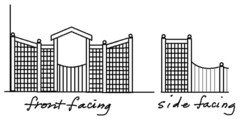
11 years agolast modified: 9 years agoThey look good. The beefy 6" x 6" posts and lattice in the center pic. look especially good. Caps, finials and picket details in all pics help, too. If you desire privacy from the street, you could have the section that divides the side yard from back yard be taller (like the lattice in the picture.) You would only need to wrap the tall section around the corner and extend it about 4' (at least ... or as much as you wish) down the side lot line. If you had a swagged gate and later incorporated an arbor, the gateway would appear window-like within the fence. Of course, the drawing is only a general scheme; you'd work out details to your liking and to suit conditions. It's just an idea.
midwestguy33
Original Author11 years agolast modified: 9 years agoGreat ideas. I actually was just at Meijer and picked up three Annabelle Hydrageas. They are bareroot by DeGroot so not sure if they were a good buy or not. I'm going to plant one on each side of the front door and one in the back corner of the backyard (behind swingset around the oaks). Should I pick up a couple more to plant back there? They don't look like they've budded out yet (I see a bit of green on one of them). Should I store them in the garage until the ground thaws? They also had tree peonies (Ronkaku and Taiyo), Pink Diamond Hydrangea, various Clematis, Lily of the Vally, Sand Cherry, Mockingbird Vine, Common Lilac, and Blue Wisteria. Any of these worth taking buying (they are between $5 and $14 each) and would work in my front or back designs?
- PRO
Yardvaark
11 years agolast modified: 9 years agoThe fence ideas ...I'm just looking for ways for your yard to cost you more. :-)
I know you have a lot of empty space in the yard. As a reminder, I'm not keeping track of what ended up where or what has lived and died. I recall some of the earlier conversation where I was encouraging you to "keep it simple" and some others were encouraging you to add a lot of variety. To be sure, there is a balance that will suit you and it is probably somewhere in between. I'd say that if the basis of the design keeps the geometry strong, simple and bold, there will be plenty of places where you can "sprinkle some spice" and a lot of it can be added any time later without detriment to the overall geometry. While there are some exceptions, most of the plants in a landscape will be multiples of something ... not one-of-a-kinds.Since the packaged plants are inexpensive, I would get them so that you could get to know them. Anything you really like and want to fit in somewhere, you may need more of it later. You may be able to use the initial plant as a source to produce more. On that list, you could try everything with the exception of the Wisteria. It needs a stout structure to grow on so would require planning ahead and construction. (I'm not sure how it does there. It's probably much less rambunctious than in the South.) The Clematis will need something to grow on, too, but it would be modest compared to what the Wisteria requires. It helps to know how the plants appear and behave in order to pick good spots for them. You might make your best guess as to where they should go, but keeping in mind that you might later be using them to hone and polish your transplanting skills. Keeping them in the garage until ground thaw is fine.
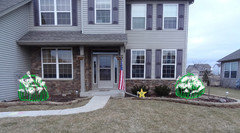
Lily of the valley did very well on the north side of our house in DeKalb. It was a nice groundcover, though non-existent in winter. Tree peonies ... a must have. Wasn't there some place near your back deck that would be good for Lilac ... another "must have" for Illinois. The 'Pink Diamond' Hydrangea seems like it would be worth trying. The 'Annabelle' would be good in the back yard where you spoke, but probably several ... whatever fits the space. I think it might be a little large for either side of the front door unless you push it off to each side, as such...
midwestguy33
Original Author11 years agolast modified: 9 years agoI worked on our plan and refined it a bit. Currently we are planning on planting three Blackhaw Viburnum (Viburnum prunifolium) on the right side (south) of the house and extending the bed out to approximately 10' (leaving a 5' path to the back fence). We're going to leave the knock out roses on the side until next year and move and replace next year. On the left side (north) we are planning on planting three Magnolia Janes (they are a small hybrid that is listed at 10'x10'). We decided to put them on the left side because of their height and because they won't bloom as early on the north, hoping to protect them from frost.
In the front we will rearrange the yews as previously suggested. The two knockout roses to the left of the front door will be transplanted to the back of the house, one of the yews will be moved from the right side to left, and a fourth yew will be purchased for the left. The bed on the left will be redone so that the retaining wall mirrors the curve of the sidewalk. We are still trying to decide if annabelle hydrangeas should be added or placed elsewhere (maybe on the left side of house by gate?). We still need to pick a shrub/perennial to "frame" the front door.
{{gwi:12408}}We are planning on planting a red oak to the left of the driveway along the parkway. I was able to prune the redbud like this:
After looking closer at the retaining wall cap, I think that ever other one should be flipped so that the angles "fit together". I know I tried this when I installed it, but it didn't work so well on the curved sections. Not sure how to handle these sections.
{{gwi:12419}}
{{gwi:12423}}Thanks as always for advice/help!
- PRO
Yardvaark
11 years agolast modified: 9 years agoAfter you said in a previous message about the cap block being trapezoidal, I understood what I was looking at. I don't think you can do anything about that (because of the curves) other than find a rectangular block/stone that will serve as a better cap for the straight runs and cutting and fitting (breaking...I've used a dull ax before and it worked well) block as needed. (In general, caps look better it they're of thicker material than the rest of the wall.) But then, it might not be worth the bother. From the street view, it's okay as is. It's only when you get close the the gaps become noticeable. It might be best to resolve with patience and groundcover. If you can establish a groundcover in the raised bed that would lean over a little (not hard to do at all) I think it would hide all the gaps satisfactorily. Could be a good place for that lily of the valley mentioned earlier. Or you may have other "groundcover" plants already scheduled for places there.
I could not sleep at night if I had a bed line like yours at the left of the entrance. It is wiggly worm homely! I've commented on it before and maybe I can persuade you to change it since you seem to be warming into a garden makeover mood. If you don't like either of my prior suggestions, come up with something clean and simple, integrated with the right side as if it all were a single retaining wall that happens to be penetrated by a walk and stoop.
We're having a late cold snap. 60* today. Brrrr!
midwestguy33
Original Author11 years agolast modified: 9 years agoI am still trying to finalize my plans for the two sides of the house and have narrowed it down to the following:
1. Plant three viburnums 'Blackhaws' (I already ordered and received these three) on the south side of the house (right side) and plant a mixture of azeleas/rhododendrons, hydrangeas and hostas on the north side (left). In this case, maybe plant a magnolia 'Jane' tree at the northwest corner of the garage?
2. Plant the viburnum 'Blackhaws' on the north side (I'm a bit concerned about their size) and plant three magnolia 'Janes' on the south side.
Any feedback is appreciated!
- PRO
Yardvaark
11 years agolast modified: 9 years agoIt would be much better if you show a to-scale plan sketch of your intentions as, in theory, it sounds fine, but arrangement is a big part of what makes or breaks landscaping. The proposed "mixture" at the left side could be great ... or horrible.
midwestguy33
Original Author11 years agolast modified: 9 years agoI did some work on the south (right) bed today but I am not sure I extended it out far enough (it is 8 feet from the house at the furthest point) or the angle is right. I figured I would post some pictures before I go any further.
This post was edited by pmsmith2032 on Sat, Mar 30, 13 at 20:01
- PRO
Yardvaark
11 years agolast modified: 9 years agoIf the wall is sitting on top of the lawn, it stands a good chance of developing uneven--wavy--elevation in the future. But you had it pretty good looking before so suit yourself if you want to install a tamped, granular setting base for it. If I was doing this, I'd first use marking paint to spray a paint line on the ground, to follow, so that the curve ends up exactly how you want it ... fluid. A major advantage to using marking paint is that it helps you visualize the end result so that you can see if any adjustments are necessary. (One note about using paint: it's greatly more useful if the marking paint can is loaded into a marking wand. If trying to bend over and spray it, it's not possible to get smooth, accurate curves. If I was only doing my own yard, I'd still get a marking wand because it helps with every single thing that's laid out. Of course, I should have told you that last year! :-o) It looks like there might be a slight "flat spot" in the curve. If there is, you could probably adjust it by tapping the base brick into better position with a 2" x 4" or something very heavy ... another block, maybe. You also could lay just the first course and make sure the curve is right before you build any of the upper courses.
I don't have the advantage of knowing what you're using for a final plan, but you should have some plan drawn to scale that shows what your going to put in the bed and how you're going to arrange it. (Here, I think we only have words.) The widest part of the bed should be sized to accommodate the trees you're planning on using. In other words, you wouldn't want to squeeze trees into a narrow portion of the bed and use the wide part only for perennials. The bed should look like a properly sized tree container. (We know that you're probably growing "half" trees ... where the back side is cut off because the house is there. So the container is not trying to contain full 360* specimens.) So far, I think it looks good and is a marked improvement over the pinched planting bed that used to be there. Make sure to view it from the street, also, as you establish the layout. Overall, it's a big improvement!
midwestguy33
Original Author11 years agolast modified: 9 years agoThanks Yardvaark. The large majority of the retaining wall is buried at least half a block down with a thin layer of paver base underneath. I didn't bury the wall at the lowest point of the curve (where I left off in the last picture) though.
Below is an updated plan showing how I plan on laying out the two sides of the house.
{{gwi:12431}}- PRO
Yardvaark
11 years agolast modified: 9 years agoYou might tighten up the like groups of like plants and bunch them a little closer together. You're not trying to display 3 separate individuals but using 3 individuals to create a larger specimen. Bringing them a little closer together helps to turn them into one large element.
The bed shape at the left could be refined to look more like it is in the same curve family as the curve on the right. Don't pinch the Rhodo/Azalea bed to tightly. Give it a little more space from the house. Maybe this is just the drawing and in real life you'd adjust. I'm just saying in case.
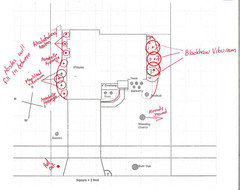
midwestguy33
Original Author11 years agolast modified: 9 years agoThanks Yaardvark! We really wanted a magnolia tree(s) somewhere but can't seem to find a home for it. We were going to plant three on the southside, but were advised against it because of the size, the fact they would bloom too early, and the fact that they would be susceptible to early morning damage from sun on frost. Any ideas?
- PRO
Yardvaark
11 years agolast modified: 9 years agoA Magnolia would be too big for the bed you're creating on the S. side. I'd watch for an appropriately sized spot in the back yard where something else you've planned doesn't pan out. Maybe you can make a swap. (I can't keep in my head all of what you have planned out. As some plants grow and get larger, you'll be able to see better how things are shaping up and it will become easier to know what things will fit where.)
midwestguy33
Original Author11 years agolast modified: 9 years agoI planted the viburnums Blackhaws on the southside this past weekend (as Yardvaark proposed) and have almost finished the retaining wall. I will post photos when finished. Do you think anything should be planted on the southwest corner of the house (between the viburnums and the redbud)?
Also, I plan on making the bed to the left of the front door (between the door and garage wall) to mirror the sidewalk. Any suggestions on what to plant in this bed (we currently have knockout roses which could be moved to back of the house)? Thanks!
- PRO
Yardvaark
11 years agolast modified: 9 years agoSW corner, probably no more tall things., But wherever you have ground, something needs to be covering it. So what are you doing for groundcover in the raised bed?
One tip for re-do of retaining wall at left of walk. It looks like there's not much grade change to retain ... as if the purpose of the "wall" is more of an attempt to keep the theme going that was started with the retaining wall at the right of walk. Both walls seem to meet the walk at the same elevation, but at the left side, that wall seems to climb one more course as it approaches the garage ... yet the grade is not climbing. I would not try to create fake grade by having a retaining wall that is basically "empty" of what it's supposed to be retaining. It's better to have that left retaining wall just be an "edging" if that's all the grade there is to retain. Creating "fake" grade makes it look gimmicky. It will look fine to stay basically level.
midwestguy33
Original Author11 years agolast modified: 9 years agoThanks Yardvaark! On the south bed I haven't really decided on a ground cover yet. I know you mentioned previously to move the knockout roses along the foundation and replace with a low-growing shrub/bush, but I think that will be a project for next year. I planted over 150 containers of various perennials using the winter sowing method this past winter, so I will probably use some of these as groundcover. Any specific suggestions on what might look nice, contrast well with the house and viburnums, and handle the all day sun/heat?
On the bed to the left of the front door, I should keep the height of the retaining wall level with that on the right side, correct? Should the retaining wall block be right against the edge concrete of the sidewalk (no more grass). Any suggestions on what might look good in this corner? It gets extrememly hot in summer because of the afternoon summer sun. I do plan on running drip tubing for irrigation in the next month or so to this bed so water shouldn't be an issue anymore.
Thanks again!
- PRO
Yardvaark
11 years agolast modified: 9 years agoThe 150 containers of perennials will surely be a helpful learning experience. By the end of the summer you'll have favorites and have learned a lot about different plants. Some of them will take another year to be fully appreciated so be patient with the laggards. Some of them may become favorites, too. If something doesn't perform well where you put it, research it's likes and dislikes and adjust it's location if you can find one that seems more suitable. As far as planting at the wall, keep in mind the idea of taller toward the back of the bed and shorter toward the front. Some of the short perennials may make good groundcovers. You'll see what shakes out, but it'll take a year of observation.
Earlier, I made A suggestion of how you might rebuild the "retaining wall" at left of walk. In contradiction to that suggestion, it could be carried straight across instead, or a variation of that. Since it's a relatively minor "wall," you might lay it out it any of the possible ways and appraise which you think is best.

midwestguy33
Original Author10 years agolast modified: 9 years agoThanks Yardvaark. We are currently debating what to plant in this corner bed. I imagine this will have some bearing on the shape of the retaining wall. Here are our current options:
1. Plant a small magnolia ('Jane' or 'Susan'). The location is ideal as it is protected from both north winds and early morning sun. It would also be a nice focal tree in spring (I've seen them planted in similiar locations in surrounding neighborhoods). However, I'm afraid it might be too big for this area (especially with the overhang) and might take away from our stone work on our house.
2. Leave the two knockout roses and plant perennials in front of them.
3. Plant two yews to match those to the right of the front door and plant short perennials in front.
4. Plant hydrangea bushes in the back and perennials in front.This area gets VERY hot in summer as it faces the west and the afternoon sun reflecting off the house really bakes the area. I will be running a drip line here so watering shouldn't be an issues. Any suggestions are welcome!
- PRO
Yardvaark
10 years agolast modified: 9 years agoI revamped an earlier sketch with a bed line that seems better suited. Those look like yews below the window and it looks like a hydrangea @ the left, but I don't think the hydrangea would work very well because of the heat. There's not as much room as my sketch suggests so maybe you don't need more than the yews and a little low perennials or groundcover in front of them.
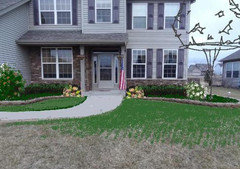
This post was edited by Yardvaark on Tue, Apr 23, 13 at 0:58
midwestguy33
Original Author10 years agolast modified: 9 years agoI've been working on the bed to the left of the front door and wanted to post some pictures before I finished:
I am not really happy with the layout (it doesn't really mirror the right side) but it's difficult with the shrubs. I'm in the process of running the downspout under the sidewalk so I can still change the contour if need be. Thanks in advance!
lyfia
10 years agolast modified: 9 years agoI would avoid doing the turning in like you have by the front entry which creates that little narrow triangle of grass. Can you just go straight into the walkway there and plant a smaller plant in that space instead. Make the bed look like it crosses over with just a break for the side walk in between.
midwestguy33
Original Author10 years agolast modified: 9 years agoThanks lyfia! I missed that part in one of Yardvaark's posts earlier. Otherwise it looks okay?
Also, not sure if I need to dig under the sidewalk to run downspout or if I can leave it. I'm running 4" PVC underground to a pop-up emitter. My options are:
1. Run it under sidewalk ( a lot of work and I'm worried about sidewalk sagging in the future.
2. Running it to middle of mulch bed (between the two yews).
3. Running it to the middle of the grassy patch just in front of the retaining wall.Thanks!
This post was edited by pmsmith2032 on Tue, Jun 4, 13 at 15:31
- PRO
Yardvaark
10 years agolast modified: 9 years agoI think Lyfia hit it on the mark as to what is wrong with the bed line.
Why are you running the downspouts into an underground pipe? It seems like you are asking for trouble ... especially when combined with a pop-up emitter. An above grade splash block (which usually becomes hidden by plants) combined with proper grading is so much simpler and trouble free.
This post was edited by Yardvaark on Tue, Jun 4, 13 at 22:08
midwestguy33
Original Author10 years agolast modified: 9 years agoAttached are a couple of new pictures of the front bed after I reworked it last night.
I have chosen to bury the downspouts because I was having issues with washouts in certain areas. For example, along the fence on both sides I was having issues and the retaining wall in this front bed was sagging from washouts. I buried the gutters as follows:
1. Attached a black plastic adapter from the downspout to solid 4" PVC.
2. Ran 4" PVC 7-14' feet away from house making sure it sloped properly.
3. Attached a pop-up emitter at the end. Pea gravel was placed directly under the elbow of the emitter and there is a weep hole in the bottom of the elbow. If the pop-up become blocked, the weep hole serves as a secondary drain. Also, the weep hole insures water doesn't sit in the pipe causing mosquito issues.I am worried now though that maybe this wasn't the best idea. I've already installed three of these to the downspouts. Maybe I should replace the pop-up emitter with a grate instead?
Thanks for all the help!
- PRO
Yardvaark
10 years agolast modified: 9 years agoThe usual fix to "washouts" that Nature uses is covering the ground with plants. This holds the soil in place in spite of what water does at the surface. (It's the solution you're using at the lawn area.) I'm speculating that your landscape has not evolved enough to accomplish this or it has not specifically been addressed. The buried pipe & emitters--while they will work now and for some time--will likely become a maintenance issue or be subject to some type of failure at some point. I would not fret about them, but I would not add more. The other solution is simpler.
It still bugs me the way the left side of " retaining wall" dips in at the walk. It adds a "busy," contrived quality to the scene. I think you would be better off going straight to the walk at 90*. Ideally, you would match the right side, but I can see why you didn't. I would have brought the right side out farther so this could happen. But if they are out of line with one another, I think it is preferable to the left side inward curve.
Also, adding work for the future, your walk could stand to be widened, especially where it meets the stoop. An eight-inch wide strip of brick or pavers at each side would help.
Whatever is planted adjacent to the walk should be low (6")
midwestguy33
Original Author10 years agolast modified: 9 years agoThanks! I agree with your assessment of the retaining wall. It looks better but still not "right". I think I'm going to extend the right side out too so both sides are equal. The barberry bushes (I think that's what the dark red bushes are) on the right need more space so I'll be killing two birds with one stone.
I was wondering if you have any suggestions on what to plant on the left side against the garage wall (where the daylilies in the pots are sitting in the pics above). I know you had mentioned something with some height but I am not sure what won't get too wide. This area does get very hot and sunny (faces west). I have planted some clemantis along the base of the trellis.Thanks again!
- PRO
Yardvaark
10 years agolast modified: 9 years agoIf you moved the trellis left about 15" to 18," it would be that vertical element. You could probably leave the Clematis where is and train onto trellis. Maybe those daylilies could go in front of the trellis (unless you have another place for them.)
The kill-two-birds-with-one-stone retaining wall solution sounds good.
On a different subject, I notice that your threads take quite a while to finish downloading as compared to others. The last time I copied one of your picture to draw on, I noticed (when I pasted it into paint) that it was huge. You might reduce the size of the pictures you upload onto your threads in order to get them to load faster. (Since I apparently forgot to upload the picture with my last post, I am including it here.)
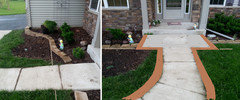
This post was edited by Yardvaark on Thu, Jun 6, 13 at 14:48
yacheryl
10 years agolast modified: 9 years agoI truely think you need a larger focal point in the left planting area instead of that trellis. You need something there that makes a bigger statement.
A wooden wheel barrow full of annual plants for summer (reds/whites) - full of pumkins and mums for fall. http://www.mygofer.com/shc/s/p_10175_27151_028W004682864001P?sid=MDx20122301x0001gpla&srccode=cii_17588969&cpncode=30-195843056-2
Or a nice bench.
http://www.benches.com/outdoor-benches/garden-benches/richmonddeluxearchedbackbench.cfm
No path needed foot traffic. It would not be used to sit on. Just to hold decor like mentioned above.Just my 2c worth...........cheryl
midwestguy33
Original Author9 years agoThe redbud mentioned above and pictured below died last year so we now need a replacement. Any suggestions on suitable candidates for this location?
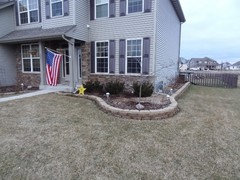
- PRO
Yardvaark
9 years agoHeard your winter nasty!
... another redbud, Jap. maple (not shrub) or serviceberry.
midwestguy33
Original Author9 years agoThanks yardvaark. January wasn't too bad but December was cold and February we set a record for cold. Was still below zero some mornings as late as last week.
Would a star magnolia or crabapple be appropriate? We already have serviceberry, Japanese maples and the redbud grove planted in the back.
- PRO
Yardvaark
9 years agoI would choose star over crab. Crab seems too dense and beefy for so close to the window.
midwestguy33
Original Author8 years agoThanks! I've been doing some more research. Is there anything that we could plant in this spot that would give us fall color? I would love to plant a Japanese Maple but I think it would get too much sun (full sun from lunch to sunset). I'm thinking serviceberry but was hoping to find something with some spring contrast (weeping cherry has white blossoms...otherwise no other color/contrast in spring). Front looks pretty barren right now as parkway oaks haven't leafed out yet).
- PRO
Yardvaark
8 years agoA jap. maple can handle full sun. Smoke tree comes to mind as another small tree with fall color and foliage color that contrasts with average green. Of course, there is burning bush in the tree form for blazing red fall color.






catkim