




|
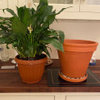
| My Epipremnum (aka "pothos") has been guttating. (I guess that's a verb. You usually see the noun form.) I wasn't worried; when I heard about guttation years ago, it was always talked about as though it was normal. But I'm still in learning-binge mode on my houseplants, so I did a search. Several of the posts here about guttation said it's an indication of over-watering. My guess is no, but of course that's coming from no experience, so I'm asking. First of all, is there really even such a thing as over-watering? I sort of thought there was only inadequate drainage, sometimes compensated for by scant watering. And for some plants in some situations I think there can be soil ecology issues, where the plant's favorite mycorrhizae will be displaced by other soil microbes if the soil doesn't dry between waterings as much as the mycorrhizae are used to. I haven't re-potted my pothos since it was given to me, and I didn't ask what the potting medium is. But it seems adequately coarse, the pot doesn't seem excessively heavy after watering, and the plant is growing at what seems to me like a normal rate. Another thing my search turned up is that guttation fluid isn't unmodified xylem sap. Another thing that makes me think so is that only the last couple leaves at the end of the shoot were guttating. Those leaves are presumably still growing, and need the minerals. Any opinions? |
This post was edited by dsws on Wed, Jan 9, 13 at 3:05
Follow-Up Postings:
|
| "Over-watering vs. inadequate drainage"; An interesting way to put it but yeah I would say that the issues are related to inadequate drainage and not over-watering since with a coarser mix you do normally use more water to thoroughly water your plants. I have always considered guttation a normal function of plant metabolism. Many of my plants do it, both the ones grown in soil or hydro and I've seen this fluid squirting out of the tips of leaves our raspberries in our garden, particularly after a good rain so water quantity certainly has some effect on it. Personally, I just clean it up where my girlfriend will yell at me about it and ignore it elsewhere. Chemically speaking, when referring to "salt" in a solution, it can mean any metal or mineral dissolved in that fluid. |
|
- Posted by purpleinopp 8b AL (My Page) on Wed, Jan 9, 13 at 9:39
| I've never connected guttation to any kind of unhealthiness since plants doing it are healthy and growing well. No idea about the chemical stuff, but my personal assumption has always been that the plant is just cycling water, dripping back on itself as kind of a self-watering system, distributing the water as needed. When heart-leaf Philos stop crying, I know they need a drink. Same with Aglaonema. It doesn't seem to be related to anything but soil moisture that I can tell although it does happen faster in higher heat/humidity, from unscientific, sporadic observation. That's just supposition, glad you brought this up. I'm curious too. |
|
- Posted by purpleinopp 8b AL (My Page) on Wed, Jan 9, 13 at 11:00
| There is a discrepancy in the reading I've done this morning. Some sources say guttation occurs whenever there is enough moisture to create root pressure. Other sources say it occurs when the stoma are closed at night while the roots continue to take in water, that when the stoma are closed, transpiration can't occur so guttation takes place. I don't put much stock in the sources that say it's excess moisture overwhelming the stoma when transpiration isn't sufficient to release as much moisture as the plant has taken in. None of them are science-y, just speculating I think, since these sources seem to indicate that guttation is a sign of a problem. I completely disagree. This is a sentence I found that seems wrong to me, "As a result, root pressure builds up - water rushes into the plant but with low temperatures, a traffic jam occurs at the stomata exit." And, " Certain uncommon conditions have to be met for guttation to occur.... Guttation happens when there is excessive water in the soil and there is an absence of water loss through transpiration." My plants that guttate are not in unusual conditions. Just because it's written on the internet, doesn't make it true. I've seen guttation mostly during the daytime... 'cuz I'm asleep at night. ...or did it happen during the night and it's just still dangling there when I notice it later? I found many "bad" sources that seemed incompetent or incorrect, but not a "good" one good enough to share. Nothing that seems conclusive one way or another. What links have people found that seem reputable, competent, based on science? |
|
- Posted by greenman28 NorCal 7b/8a (My Page) on Wed, Jan 9, 13 at 11:19
| Hmmmm, my Pachira (Money Tree) always guttates, and I'd say it's a healthy tree for sure. Certain species are probably prone to this behavior.
Josh |
|
| It sounds as though guttation is indeed related to root pressure: "Experimental and control plants were exposed to mineral solution during the night (MN-plants) and day (MD-plants), respectively. ... Finally, the water movement caused by root pressure is taken as 150 ml. This is based on the fact that guttation drops appeared only on MN-plants during the night, and the difference in the water lost during the night between MN- and MD-plants was 150 ml ... ." Last night I was thinking that guttation helps with mineral transport. But that article also points out that mineral transport is done much, much more by the flow of water for transpiration, growth water, and circulation of phloem sap back to the roots. Transpiration exceeds guttation by something like a hundred-fold for the plants in that article. Now I'm thinking that the main function of guttation is to get rid of elements the plant doesn't want. For example, "Salt stress aggravates boron toxicity symptoms in banana leaves by impairing guttation." So I conjecture that heavy guttation, in a type of plant that doesn't always have it, means your micros are out of balance. If someone has the materials to try it, here's an experiment. Grow a bunch of some plant that commonly guttates, but not universally. Use a potting medium, a main fertilizer However, I would expect that some plants have evolved under circumstances where one or more micros are almost always present in excess. Those plants will guttate all the time (unless prevented by dry/salty soil or drowned roots), because there's no point regulating something that you always want to have turned on. And other plants shed leaves fast enough (or lose them to herbivores fast enough, or die back for the winter soon enough) that they can just let their excess micros accumulate in the leaves, and not worry about it. Hence the specification of a plant that guttates readily but not consistently. |
This post was edited by dsws on Wed, Jan 9, 13 at 13:06
|
| Another piece of vocabulary: the place the guttation comes from is called a hydathode. http://en.wikipedia.org/wiki/Hydathode And another thought on the purpose of guttation: the sugar in guttation fluid may not just be lost because retaining it would cost more than it's worth. Maybe it's there to help support commensalists. Suppression of Bacterial Blight by a Bacterial Community Isolated from the Guttation Fluids of Anthuriums |
|
- Posted by greenman28 NorCal 7b/8a (My Page) on Wed, Jan 9, 13 at 13:23
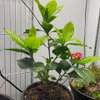
| Interesting thoughts, Dsws. For several years, I never once fertilized or re-potted my Pachira, Here's my plant...grown from a single broken leaf.
Josh |
|
| Guttation is normal and not necessarily a sign that anything is off balance. I'm hoping that you all understand what transpiration is. Water and dissolved elements are absorbed into the xylem tubes of the vascular system. Xylem tissues carry liquids UP from the root hairs all the way to the leaves where it evaporates via the numerous stomata located on the upper and lower surfaces. Evapo-transpiration is a mighty force.....a mature tree can transpire several tens of thousands of gallons......a day! It is entirely driven by evaporation. At night, evapo-transpiration ceases. If water continues to load up at the roots, it has to get out somehow. That's where those little hydathodes along the margins come into play. Some kinds of plants guttate practically every night; it's simply part of the natural physiology. Haven't you ever noticed how your lawn always seems to have dew (condensation) on it every morning, even when nothing else does? It's not dew. If your houseplants are guttating excessively and often, you might be watering too frequently....or the potting medium stays too moist for long periods of time.
|
|
- Posted by purpleinopp 8b AL (My Page) on Wed, Jan 9, 13 at 17:54
| I agree that it's normal, just not sure when it happens or why. Knowing that it happens at night on grass doesn't close the door for me on the issue for all other plants. Poetically: It's not dew... on your shoe. Regarding the handful of plants I have that do it, I would have to see signs of some kind of unhealthiness before I would consider anything was being done too much to a plant, water, fert, humidity, any of the maladies proposed here or elsewhere out there that are supposed to be the cause of guttation. I can't find any time-lapse vids of guttation, btw... but if they didn't call it time lapse guttation, how would they expect my search for such to find it? (P.S. Who's got a little part of them who thinks it's plant pee?) |
|
| Josh, do all leaves of your Pachira guttate more-or-less equally? If plants have specialized organs to do it, that means they're doing it for a reason, rather than having it be something that just happens as a passive result of root pressure. Plant pee is my current favorite. Here's a page that mentions guttation in zinc-deficient plants. I wonder whether that's because of antagonism from iron or phosphorus. (Sticking with the plant-pee hypothesis.) Here's someone saying they notice it especially on new leaves of their banana plant: |
|
- Posted by greenman28 NorCal 7b/8a (My Page) on Thu, Jan 10, 13 at 11:25
| I only find it on the petioles of the leaf or as beads along the central vein of a leaf. I've never given it a second thought, really...other than to mention to others that it happens
Josh |
|
- Posted by plantomaniac08 8 (My Page) on Thu, Jan 10, 13 at 17:28
| I see it occasionally on my peace lily and I've never seen signs of overwatering on the plant. No yellow leaves or other signs that are inclusive of overwatering since I purchased the plant last year I also think it's normal. Planto |
|
- Posted by greenman28 NorCal 7b/8a (My Page) on Thu, Jan 10, 13 at 20:00
| I see it primarily on fresh new growth, if that helps any.
Josh |
|
| Overexpression of GLUTAMINE DUMPER1 Leads to Hypersecretion of Glutamine from Hydathodes of Arabidopsis Leaves http://www.ncbi.nlm.nih.gov/pmc/articles/PMC514164/ The above article contains some commentary in its introduction about the state of ignorance on the subject of guttation. Plant pee still sounds likely to me, but no one really knew as of 2004. |
Here is a link that might be useful: Overexpression of GLUTAMINE DUMPER1 Leads to Hypersecretion of Glutamine from Hydathodes of Arabidopsis Leaves
|
| Guttation is a plant's way of eliminating excess water from its leaves. Some plants do it a lot, some don't do it much at all. I see it on some plants in my garden from time to time, and it's normal. |
|
| Sending water to the leaves costs energy, and should be easy enough to cut back when it's not needed. Why would plants do that, just to dump it? Alternatively, what evidence is there that eliminating excess water is the purpose? |
Please Note: Only registered members are able to post messages to this forum. If you are a member, please log in. If you aren't yet a member, join now!
Return to the House Plants Forum
Instructions
- You must be a registered member and logged in to post messages on our forums.
- Posting is a two-step process. Once you have composed your message, you will be taken to the preview page. You will then have a chance to review the contents and make changes.
- After posting your message, you may need to refresh the forum page in order to see it.
- It is illegal to post copyrighted material without the owner's consent.
- HTML codes are allowed in the message field only.
- No advertising is allowed in any of the forums.
- If you would like to practice posting or uploading photos, please visit our Test forum.
- If you need assistance, please Contact Us and we will be happy to help.