


|
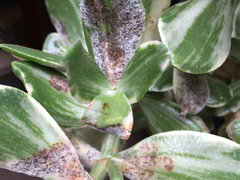
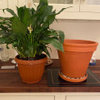
| My Jade Plant has had a few rounds with Powdry Mildew since bringing it in from my deck in late October. Because I live in Michigan and its winter its hard to get good circulation in the rooms. I've done the natural method of mixing dish soap, baking soda and water together and spraying it down and the soil as well. But it just keeps coming back. Half of the plant has completely died off. Is there anything else I can do? Would putting a fan in the room help? |
Follow-Up Postings:
|
| Jade is very sensitive to soap applications. It may be that which has caused the death of parts of the plant. |
|
- Posted by hopefulauthor z5IL (My Page) on Mon, Jan 24, 11 at 14:00
| Cardarlin. I'd like to add to Rhizo's advice. High temps, high humidity, over-watering and low light contributes to powdery mildew. Since grouping plants raises humidity, it's best keeping your Jade solo. Jades prefer cool temps, high light, low-little humidity and well-draining soil. What's the temperature in the room Jade lives? How often do you water? These are questions you have to ask yourself to figure the cause of mildew. Are you fertilizing? There's no need to fertilze Jades in winter, especially since you're in MI. Avoid chemical fertililzers w/high Nitrogen. Two most important factors are: Jades/succulents need sun, (the more the better,) and well-draining soil. It's probable you've over-watered. Do you check soil before giving soil a drink? Does the pot have drainage holes? I found this recipe online. 1 teas of Baking Soda You did the right thing spraying with Baking Soda, especially if it was applied as soon as you noticed mildew. Spray once a week with the Baking Soda solution. Hopefully, your Jade will resume to health..In the future, be careful when watering, place your Jade in a cooler room with the brightest light. Artificial light strengthens foliage. Any light will do. Good luck, and keep posting..Toni
|
|
| There's good news, good news and bad news about this subject. I have a large specimen jade that developed a serious case of powdery mildew when I brought it in from outdoors in the fall. Apart from following all of the good housekeeping practices (not overwatering, removing the dead leaves, ensuring adequate ventilation, and washing my hands after working on the plant), I treated it with a fungicide containing propiconazole, in this case Honor Guard PPZ. After consulting the application instructions, I determined that the application rate should be 8 oz. per 100 gallons. I went to my local drugstore and the druggist gave me a free eye dropper that was calibrated in ml. I also purchased a cheap plant mister for less than two bucks at my local odd lot store. I mixed 2.3 ml. of the fungicide in one gallon of water and applied it with the plant mister to the tops and bottoms of all leaves and stems until the liquid was dripping off (i.e. everything was wet). You should follow the MSDS instructions and do this somewhere where the runoff will not be problem (e.g. outside or on a large plastic sheet). Also observe the handling and personal protection warnings. The good news is that the fungicide did not kill the plant. The other good news is that the powdery mildew is completely gone (I pinched off all of the dead or dying leaves a week after treatment), the plant has returned to good health and is setting new leaves, etc., approximately eight weeks after treatment. The bad news is that a 4 oz. bottle of Honor Guard PPZ (available from Control Solutions Inc.) is around thirty bucks. Mind you, if you have a large plant that you wish to keep, it is well worth it and you should have enough fungicide to carry out literally hundreds of treatments. |
Here is a link that might be useful: Honor Guard PPZ product label
|
| Tebuconazole is also available inexpensively over the counter and is an extremely effective systemic fungicide. It's an approved chemical for houseplants, but shouldn't be sprayed indoors. I've used it to treat plants prophylactically for a number of years and haven't yet had a plant react poorly to it. As always, if you decide to use it either as a prophylactic or fixative, read and follow label instructions carefully. Al |
|
| ARE YOU KIDDING ME, TRAINBOY? Did you follow all of the "must" directions regarding proper, safe, and legal use? I'd like to see pictures of you in the protective gear, lol. And this dangerous chemical is not recommended for indoor, household use. |
Here is a link that might be useful: Click here
Please Note: Only registered members are able to post messages to this forum. If you are a member, please log in. If you aren't yet a member, join now!
Return to the House Plants Forum
Instructions
- You must be a registered member and logged in to post messages on our forums.
- Posting is a two-step process. Once you have composed your message, you will be taken to the preview page. You will then have a chance to review the contents and make changes.
- After posting your message, you may need to refresh the forum page in order to see it.
- It is illegal to post copyrighted material without the owner's consent.
- HTML codes are allowed in the message field only.
- No advertising is allowed in any of the forums.
- If you would like to practice posting or uploading photos, please visit our Test forum.
- If you need assistance, please Contact Us and we will be happy to help.