



|
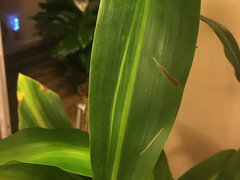
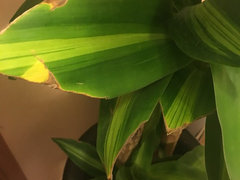
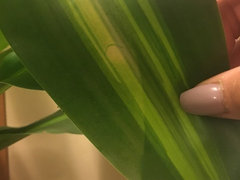
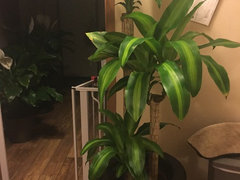
| My housplant's leaves are turning yellow and brown. I do not know the cause and need some advice.
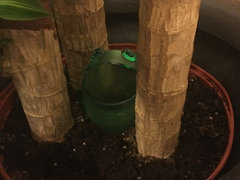
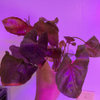
Here are some pictures of the plant: |
Follow-Up Postings:
|
| Asial, I think your plant is the "aspidistra" elatior...the cast iron plant. This plant, true to its name is a tough plant to do harm to because it stands up to adversity much better than most. It takes low light situations but demands higher humidity. In the place you have it, it does seem to be where humidity is not its strong point. It is also hard to tell--the bottom of the pot isn't shown in your pictures...cant tell whether you have something there to catch drainage. Possibly the pot is of plastic make up which does hold moisture longer than say...clay. It would serve you better to tell us in what kind of exposure...i.e. in what kind of light you have it...from what direction. The conditions suggests possible causes for the browning of leaves. Overwatering is the one most often cause of what you see. The plant, as suggested, looks like it doesn't drain well. Plants must drain, otherwise, water builds up in and around their roots which in very short time starts to rot and once that starts, there's hardly any plant that can stand up to it. Leaves are the first sign. Your plant should be kept on the moist side...but that doesn't mean it can be kept wet or soggy. That begets rotting roots. The water should not be cold. From out of the tap, water should be allowed to gain room temperature before applying. If you give it more light by putting it closer to a window, you can try giving it a northern exposure which is very low at this time. As sunlight improves toward February, draw it back from the light. Give it a position behind curtains but yet allows good light. Your plant's leaves can be clipped back with a sharp pair of scissors. Any dead or dying leaves can be removed. If, as I suspect, your plant has been overwatered due to poor drainage, you must correct that. The condition of the plant might warrant a look-see at the roots to make sure they are not rotting. This normally calls for the plnnt to be unpotted. If the soil there is unusually damp or wet, you can place the blame at the feet of your watering habits. If you suspect it is not a watering problem, then look to possible invasion of pests and treat accordingly. |
|
- Posted by mr_subjunctive 5 (My Page) on Wed, Jan 2, 08 at 22:36
| The plant is a Dracaena fragrans massangeana (corn plant). Aspidistra is a whole different thing. My guess would be that the plant is too wet, but it's very hard to say because you don't tell us anything about the conditions they're in. How much light are they getting? Window or artificial? If a window, which direction does it face? How do you decide when to water? How often do you wind up watering? Are you feeding the plant? How often? Is it in a draft, or a heating vent? What's the usual temperature in this location? Has anything in the plant's environment changed in the last month or two? How long have you had the plant? Etc. |
|
| This plant is Dracaena fragrans with a watering issue.
|
|
| I agree with mr-subjunctive it is not a Aspidistra. It is so far from a Aspidistra it isn't even funny. It's definately a Dracaena aka corn plant. Overwatering is the number 1 cause of dying houseplants. Yellow leaves are a symptom of over and underwatering. It appears the soil may not have any perlite or other course material to allow it to drain so the roots are always wet. Check the roots to see if rotting, they will be brown and mushy. If so, repot it in proper soil and do not fertilize until it recovers and the leaves aren't droopy. The less light the plant gets the less water it mostly likely will need. |
|
- Posted by pirate_girl Zone7 NYC (My Page) on Thu, Jan 3, 08 at 1:50
| Definately a Dracena, I couldn't say which, but no way Aspidistra. I grew this a very long time ago, never saw this problem. Looks more to me like underwatering or too dry. I too would cut off the damaged leaf tips, if you can picture it, cut it back just past the damage, trying to cut & shape like the original leaf silhoutte. If it were mine, I'd unpot it to see what's going on w/ the mix, is it drying up & hardening off, is it losing roots? |
|
- Posted by maidinmontana 5 (debirosin@bresnan.net) on Thu, Jan 3, 08 at 16:50
| I have one of those but mine is full all the way down to the soil level in the pot. It doesn't get watered as often as my other plants, but I never let it get really dry either, when I do water it it is just enought to dampen the soil, not make it spongy. Mine is in a ceramic pot which doesn't dry out as fast and gets decent sunlight in the morning. I swear it grew 3' this past year. I just wish the stalks would get big like yours. I noticed it looks like it is setting at the bottom or landing of a stairwell, could be a light issue, how long have you had it there? Yellowing to me has usually meant over watering but your soil looks to be on the dry side. Maybe it is an overdose of fertilizer? |
|
- Posted by greattigerdane z5NY (My Page) on Thu, Jan 3, 08 at 17:28
| I'd say the problem is either being kept too wet or too dry and maybe the light is too low as suggested. Here's a link to an "Aspidistra" plant below. Billy Rae |
Here is a link that might be useful: Aspidistra
|
| The leaves look shinny-I hope you aren't using a product to do that. I used to have a corn plant years ago. I too think over watering could be the problem. My helpful hint would be less is best. Check the plant with a magnifying glass to look for bugs. Make sure it gets some light and water it only after it is dry way down in the soil. Pick the pot up after you water it. In a week or 10 days lift the pot again. It should feel alot lighter if it needs water. Sometimes I have had to poke extra holes in the bottom of my planter to make sure the water is draining out. If your plant doesn't have drainage you will probably need to repot-but not in a bigger pot. Good Luck |
|
| I'm with toots, Look for spider mites. It also looks like fertilizer burn. The soil doesn't look too moist, but with the glazed pot, it could be down further. I'd do a flush with water and give it a nice warm soapy shower and see if it perks up a bit. Then let it dry before watering again. I'd also get a moisture meeter if you're going to keep it in a glazed pot, to make sure ti dries out between waterings. |
|
- Posted by watergal z6/7 Westminster, MD (sjohnson13@aol.com) on Fri, Jan 4, 08 at 23:50
| I'm fairly certain your corn plant is suffering from overwatering - the brown tips with the yellow stripes suggest that. Underwatering tends to make a faded, pale yellow leaf that is more evenly yellow, not just at the end. This plant needs to get almost completely dry all the way down in the pot before you water again, every time. It doesn't look like spider mites or other pests. Could be fertilizer burn - I have discovered that plants moved from bright light to low light often show symptoms of fertilizer burn from existing fertilizer in the soil, even if you haven't added any more. It also looks like it could use more light, if that's possible for you. You can take a sharp scissors and recut the tips of the leaves into a point if you want to improve its looks. I wouldn't worry about the leaf shine - it's not a big issue. I personally don't like the water meters - I find that using your finger is much more accurate. |
|
- Posted by ronalawn82 z9FL (toulsa@verizon.net) on Sat, Jan 5, 08 at 8:34
| asia122, I see three stalks; the tallest appears to be without the symptoms. Whatever the condition, I expect that this stalk will eventually show symptoms. Examine the shoots that show the symptoms. Are they firm if you try to gently twist them in any direction? If you are in doubt, do the same with the shoots on the 'healthy' stalk for comparison. Is the 'neck' of these shoots constricted rather like pencil-necking of outdoor queen palms? Again use the healthy stalk or any healthy 'Mass. cane' stalk for comparison. Is there any (especially black) discoloration? Any of these symptom can indicate that the shoot is dying. From there, go to the stalk to which the shoot is attached. Try to determine whether the bark is firm or separating. Lightly grip the stalk and twist/massage it and you will feel the bark wanting to slip or slide over the stalk. If any of this happens, it might indicate that a rot has set in; sometimes this appears to be moving downward and the stalk can sprout healthy shoots lower down or you can induce this by cutting back the stalk to healthy tissue. The cut surface should be sealed with wax. If the rot is moving upward, there is little hope for that stalk. Someone posted that a black spot may be observed on the stalk when the rot has set in. I have not seen this on the 'Massangeana' or other cvs. of D. fragrans. I have seen a black band on the stalks of D. marginata and D.deremensis which later turned out to be a forewarning of bad things to come. If no rot is indicated, then over watering should be an issue of interest, if not a prime suspect. The plant appears to be 'direct planted' in a container that does not drain (I cannot be sure if there is a saucer under the container). Every instinct tells me that this is not good for the plant. You want to make sure that the potting mix is "dry enough" throughout the full depth. Use a dowel rod or similar probe to determine the condition right down to the bottom of the container. If there is evidence that there is water collecting in the bottom, that needs to be corrected yesterday. If it is only that the mix is merely 'wet', then you can ameliorate the condition by replacing some of the wet mix with dry mix. Scoop carefully from the top and work downward. You do not want to disturb or destroy the roots. They are probably six or more inches down but be careful. Replace with dry mix in small doses and firm down before adding more. The objective is to encourage the dry mix to 'suck up' the excess moisture from below. You will most likely be able to save that tall stalk if not all three. |
|
- Posted by Spencer Florida(Suspence33@yahoo.com) onWed, Jan 19, 11 at 20:54
| I was having an issue with mild growing on the soil due to overwatering. To kill the mold and dry out the soil I made the mistake of placing it outside in direct sunlight. Needless to say the leaves are now burned and the green pigmentation is gone and the leaves are all yellow. Can I save this plant and return it back to it's healthy state? |
|
| @Spencer Florida Sounds like my plant is in the exact same condition,cant seem to find out if it can be returned to original state. |
Please Note: Only registered members are able to post messages to this forum. If you are a member, please log in. If you aren't yet a member, join now!
Return to the House Plants Forum
Instructions
- You must be a registered member and logged in to post messages on our forums.
- Posting is a two-step process. Once you have composed your message, you will be taken to the preview page. You will then have a chance to review the contents and make changes.
- After posting your message, you may need to refresh the forum page in order to see it.
- It is illegal to post copyrighted material without the owner's consent.
- HTML codes are allowed in the message field only.
- No advertising is allowed in any of the forums.
- If you would like to practice posting or uploading photos, please visit our Test forum.
- If you need assistance, please Contact Us and we will be happy to help.