







Ficus lyrata problem
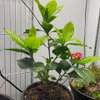
I bought a ficus lyrata about a month ago. It is sitting right by a window that gets lots of sun in the morning, and good indirect light the rest of the day. It has been dropping leaves quite consistently and at this rate will be totally bare within another month. The leaves just turn yellow and crispy and fall off (or come off easily in my hand).
I've heard these plants are sensitive to changes in environment. Is it possible that it is still adjusting to the move from the nursery to my apartment? Should I just wait this out? I'm afraid it's going to lose all of its leaves.
Comments (55)

keltic_pickle
Original Author15 years agoVery interesting! Not sure I entirely understand what you mean about the wick. I'll search around to see if I can get a more detailed description, but if you care to elaborate, I would certainly be appreciative. Thanks very much!

tapla (mid-Michigan, USDA z5b-6a)
15 years agoYou can use a wick to drain water from the saturated layer of soil at the bottom of the container. Adding a wick & allowing it to dangle below the container "fools" the water into "thinking" the container is actually deeper than it is. The water moves down the wick in search of the deepest part of the container. When it gets to the bottom of the wick, the water moving down behind it "pushes" it off the wick.
That is the simplified version. If you want the technical explanation, read this.
Al
Related Professionals
Maple Valley Landscape Architects & Landscape Designers · Mitchellville Landscape Architects & Landscape Designers · Concord Landscape Contractors · Waterbury Landscape Contractors · Americus Landscape Contractors · Berwyn Landscape Contractors · Centereach Landscape Contractors · Fort Mill Landscape Contractors · Old Saybrook Landscape Contractors · Paramount Landscape Contractors · San Bruno Landscape Contractors · Wilton Landscape Contractors · Fort Smith Interior Designers & Decorators · Little Egg Harbor Twp Interior Designers & Decorators · Hillcrest Heights Handymanxanthoria
15 years agoI have a follow up question: I have had the same problem with a ficus lyrata I bought - the 5 canes in the pot now only have leaves at the top, though the leaf drop has stopped.
Will the leaves regrow along the stems/canes?
pirate_girl
15 years agoI doubt it, but I'll let Al (Tapla), our resident Ficus maven address this. (Waving, hiya Al).
jeannie7
15 years agoI don't know whether you go along with the "wick" method of watering, but you are the judge whether you believe the plant has been overwatered.
Given that plants must be watered, and therefore, its the roots that must receive the water, we assume from our watering habit the roots are receiving what water we give it.
The easiest way of telling is by watering so that it exits the bottom of the pot into a holding vessel, usually a saucer, and there let it drain fully before dumping such excess.
To leave it there invites the water that has just been gotten rid of, to re-enter back up to the roots that just got rid of it.Yellow leaves, usually at bottom, because that's the leaf closst to the problem, is caused from either over or underwatering. But, when it is the lower leaves that are yellowing, and possibly falling off, its due to the light levels not being sufficient. Move it so that it receives the best light available. That speaks for a southern, or western exposure.
If you've been fertilizing, the plant, at this time of season, is probably not using it. Its not growing. The food is being force fed to a plant it cant use.
You would be the judge here also.Hopefully you don't really mean the plant is allowed to dry down completely. When soil dries out, it shrinks. Sometimes the soil shrinks away from the sides of the pot.
This causes any watering to slide down the sides, to the drainage holes. In the meantime the water doesn't get to where it is intended....the roots. When the water is seen in the saucer, the thought is the plant has been watered when in fact, it hasn't.Never let a plant's soil dry out completely. Dry down..yes, but use your finger to test whether there is dampness below and if not, water. If there is, let it go another couple days, and test again.
Or use a viable humidity tester which can be bought at any garden center.It is common for plants to lose some leaves; usually the bottom ones due to a change in environment.
Your heated air is different, your water from the tap, might be quite different that what had been given;
Hopefully you have not given the plant water that is on a softening system. That will cause a plant to have problems most definitely. Water given plants should be allowed to sit overnight, to gain room temperature and not be too cold....as from a tap which can cause it stress.Usually the cause of dropping leaves is because the air in your home is quite different. Your furnace is on and you problably keep the temperature at about 68º = 72º...or maybe higher. Plants usually like lower temperatures during nighttime ..in the 60º - 65º range.
tapla (mid-Michigan, USDA z5b-6a)
15 years agoIt's a somewhat complicated answer, but YES, you can make them grow there (back-bud).
Trees will back-bud with no help from us when light intensity is high and penetrating to the interior of the tree ('interior' part probably doesn't apply in your case), nutrition is in the adequate to luxury (a real term) range, there is good air movement around the tree, and soil structure is conducive to good root function/metabolism.
If one or more of these requirements is suspect (and on your tree they must be - because of your description) you can still force back-budding by tip-pruning either selectively or over the entire plant. For Ficus, simply remove the growing tip and the last leaf that emerged from each branch you wish to increase branching on. This causes changes in growth regulators/hormones that stimulates latent buds in leaf axils, and above old leaf bundle scars, if the plant was growing robustly at the pruning. The end result is more branching and branches that grow densely instead of overly long.
Al
tapla (mid-Michigan, USDA z5b-6a)
15 years agoHi, Pirate Girl. I was too busy typing to see you waving. ;o)
BTW, Xanthoria - I should have mentioned that it's not normal for there to be foliage only @ branch ends on this plant. There is something causing that condition, and the most likely cause is lack of light - being severely undernourished could also cause it, but it's unlikely it's an over/under-watering issue, unless the existing foliage is exhibiting symptoms you didn't mention. Hopefully you'll be able to ID and correct the problem.
Your tree likes a fast soil that doesn't stay soggy, weak doses of a 1:1:1 or 2:1:2 ratio fertilizer, bright light, and temperatures consistently in the 65-80* range. You can allow the plant to dry to the point where the soil first feels completely dry at the drain hole with no ill effects, and you SHOULD allow the planting to dry down considerably between generous waterings.
There are some statements that are simply not true in the above post:
Yellowing leaves low on the plant are not unequivocally water related. Mites and a macronutrient deficiency (particularly N) are both very common causes of yellowing/loss of older leaves.
You cannot "force feed" a plant or make it "eat" too much fertilizer. Plants take what they need and leave the rest. You must, however, be careful about not applying so much fertilizer that it makes it difficult or impossible for the plant to take up water and the nutrients dissolved in it.
The inexpensive moisture meters you buy at plant stores are useless for determining moisture content. They measure electrical conductivity - not moisture. To prove this, dip the probe in a cup of deionized (distilled) water. The meter will read 'DRY'. Dissolve a tsp of salt or fertilizer in the same water and it will read 'WET'. Inexpensive moisture meters are better at reading fertility levels than moisture levels.
I hope you've found my offerings at least somewhat helpful. Take care.
Al
muse55_att_net
12 years agoI live in hot Houston, TX., and my ficus lyrata, which I bought a month ago and put in my outdoor atrium open to the sky, has a problem with its TOP leaves. They first turn brown from the outside ends, then gradually white, and are as dry and the same color as parchment. This plant is about 5 feet tall, and has now lost 6 of the top leaves. I was told this plant loves direct sunlight, which it can only get about 3 hours a day at most, but it appears that these leaves are burned, as though something is literally burning the plant at the top, and all I can think of is the sun. I repotted the root-bound plant when I got it but didn't separate the roots as it was too hot here. It's in good potting soil, and I saturated it with root stimulator when transplanting it. For a month it's looked fabulous, and now in the last week it's looking awful. If I sprayed it with Miracle Gro on a hose-end feeder, do you suppose that's what's causing the top leaves to burn? I moved the plant to where it gets only filtered light today, to see if that helps. HELP, I LOVE THIS PLANT!!!
tapla (mid-Michigan, USDA z5b-6a)
12 years agoLyrata likes bright but not direct sunlight, so it's possible you're seeing photo-oxidation (sunburn). You could have easily skipped the "root stimulator" at repot time as it unnecessarily adds to the TDS/EC (salt level) of the soil solution and makes it difficult for plants to absorb water. The best and most efficient pathway for nutrients to make their way into the plant is roots, especially when the plant's foliage is as thick and rich in cuticular waxes as that of your fiddle leaf fig.
There are two ways to look at how we deal with troubled plants. One is to try to isolate the problematic issue and treat it on a per case basis, the other is to learn to make cultural conditions as conducive to robust growth and good health as possible so these issues never arise in the first place. Everything starts with the roots, the heart of the plant. If you can make the roots happy, and get a good nutritional supplementation program in place, the rest is really pretty easy and 3/4 of the heavy lifting is already done - the plant can generally do the rest, as healthy plants that are growing well & showing good vitality are far less prone to issues like disease and insect predation because their natural defenses are armed as a byproduct of their normal metabolism.
There is nothing we can do for/to plants to get them to grow better than they are genetically programmed to grow - nothing - it can't be done. Our job is to eliminate to the greatest degree possible those influences that ARE limiting so plants can grow as close to their genetic potential as possible.
It may be helpful to read the info at the link below. If you have other questions, you can ask there or here. I have more than 30 Ficus covering about 10 different species growing as bonsai or as pre-bonsai, as well as hardy figs (carica), so I'm very familiar with the genus as a whole.
Al
Here is a link that might be useful: More about Ficus.
LauraNetherlands
10 years agoHi there,
We bought a ficus lyrata about 4 weeks ago and the first two weeks it looked great, and we haven't been overwatering, also: nice light-exposure but not too much. Now the leaves are starting to "curl/wave" along the edges. On two leaves near the mid-section I'm seeing crater-like buldges... no browning/yellowing yet. Our gut-feeling is saying to give it more water since it has lost some of its amazing fierce greenness it had when we just bought it, but we don't want to drown it.
I'm a bit sad about its state actually, hope someone can help.
Greetings from Europe!
Laura
(I've attached a picture)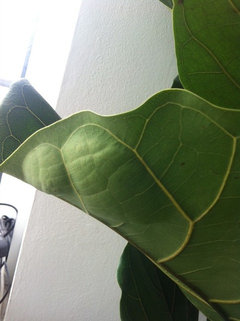
denes_gyorffy
8 years agoOla,
Not sure if there is still someone reading these, just saved a plant from my friends unused apartment, brought it home i have taken it next to a window, watered misted it, a couple days ago i have noticed the same dents as the photo above! First only on one or two leaves, today it is 4-5 leaves? What should i do, is that a typical sign?

lilce51286
7 years agoPurchased in June and now there's no leaves. I overwatered from what my research said and so I allowed the plant to dry out for 1 full month which would be July. In
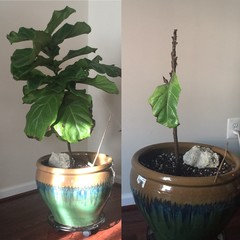
July all leaves fell off. Today August 5,2016 I lightly/I mean lightly watered w/organic seaweed & protek. Any advice on how to spark new growth? I cut the top part of the stem to make sure it wasn't dead/dried up and it started oozing this white substance so I know the woody tree stem is still alive. I'll water only 1 time a month now to give it a complete break since there's no leaves. I live in a dry townhouse, east coast Maryland. Has this happened to anyone before? Any advice? Potting mix is epsoma w/extra perlite & top dressed w/orchid bark. Before I overwatered picture and the August 5, 2016 current state of my plant picture (no leaves)tapla (mid-Michigan, USDA z5b-6a)
7 years agoThe plant is in Espoma (soil perfector?) and perlite only? If so, there's your issue - a month w/o water in that mix = dry soil = drought response = shedding of foliage to conserve what water the plant has stored. You'll need to water much more often than that, and you'll also need to stay right on top of your nutritional supplementation with a fertilizer that has ALL nutrients essential to normal growth because the plant gets almost nothing from the soil. Foliage-Pro 9-3-6 is probably your best bet.
If it's not Espoma Soil Perfector, we need more info.
Allilce51286
7 years agolast modified: 7 years ago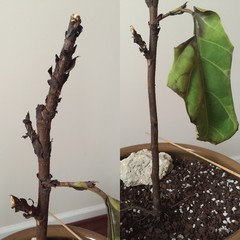
Hey Al,
No I was told by the garden shop homestead gardens to be exact that this plant needs watering every 2 weeks. So I did and even though the top soil level was dry, inside the center /bottom of the plant pot I knew was still moist, it's a big plant pot, but I followed her instructions. So the pot never fully had a chance to dry out. Homestead Gardens here uses Epsoma Organic Potting Mix w/micro tone and they always recommend buying an extra bag of perlite to mix into the Epsoma bagged soil to aid in extra drainage. I've been follwoing this same method for all my plants when I pot them and have epsoma soil at home in a medium air tight container. I just added the dry bark on top of the soil once all my plants are done being potted; since we have tiny Gnats that come from the outside, and for some reason I learned they don't like plants that are top-dressed. Guessing since the soil isn't exposed they can't lay eggs.
All through June I watered every 2 weeks. I realized at the end of June the leaves curling, becoming darkened, and I stopped watering immediately. The 1st week of July leaves began to drop 2 a day and all the leaves were filled w/big black spots and dried edges. I stopped watering once this happened and I have a long bamboo stick I use for all my big indoor trees to see if the center of the plant is still wet. I did this method w/the Fiddle and the stick came out soaking wet which I knew was the issue. Over watering. So in July I let the plant dry out and each day until the end of July all the leaves fell off. The plant has been Over watered by me. Now it's the first week of August the pot is dry finally and yesterday 8/5 I lightly watered w/a mixture of dyna gro pro-tekt and Neptune organic seaweed. I used only a small amount because there's only 1 leaf left and even that is going to fall off. I cut back the top portion of the stem to make sure it isn't dried inside/the plant started oozing.
Im going to water only 1 time a month like I do my rubber tree because it's so dry in here and my plants don't dry out fast at all. Even my peace Lilly gets watered sparingly because it's able to hold onto moisture in here. But I'm mainly going to water the fiddle 1 time a month because there's not going to be any leaves soon and no real reason to water often since photosynthesis won't be taking place. I'll make sure the root ball doesn't dry out of course. I Don't want to run the gamut of killing it completely. Do you think there's a chance of regrowth by Feb 2017 or should I toss this tree away? I messed up and should of listened to my intuition because I have other big plants and haven't had any issues w/watering or anything. Here's a closer picture of my fiddle fig stem - just sad about this especially when I asked the lady specifically about my home conditions.
lilce51286
7 years agolast modified: 7 years agoHomestead Gardens I go to here in Annapolis, MD only uses Epsoma organic potting mix w/micro tone and they sell these bags in bulk. In their workshops they have a separate container where they show you how to mix bag soil w/extra perlite and pot up your plant. You see them open the Epsoma organic potting mix, pouring it into a container halfway and then cut open a bag of perlite, and they pour some in. Next you see them pouring the remaining bag of the Epsoma soil and mixing it all together by hand. The instructor takes the empty plant pot, removes your plant from its old container, and with a measuring cup uses the soil mix and pots up your plants for you. I've been using this soil mix method for all my indoor plants and it works great. I water my indoor/outdoor plants w/Neptune organic fish or seaweed and I also use Dyna Gro protek (if their weak or in the winter time). I use the liquid Dyna gro plant food 7-9-5 for all my indoor plants. Inside my house the air is very dry and all of our townhouses have the same issues. Which in the summer I don't water my indoor plants as often because I don't need to. It takes longer for indoor plants to dry out. The top portion of my plants will be dry but when you stick your finger in it, a water meter, or even a stick you'll find that the plant is still wet in the center, and so I won't water them. Hope this gives you a better information to help me. Thanks for answering
tapla (mid-Michigan, USDA z5b-6a)
7 years agoThat's a huge pot for the size of the plant, so over-potting is a real concern.
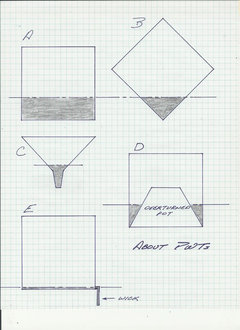 Look these images over, paying closer attention to the picture with the over-turned pot and the last on on the bottom page w/the bricks.
A perched water table (PWT) is water that occupies a soggy layer of soil at the bottom of the pot and what's harming your plant. Reducing the ht of the PWT and the volume of water it can hold will be very helpful. You reduce the ht by increasing your soil's particle size. You can reduce the volume of water the PWT can hold by using ballast - the bricks and over-turned pot are types of ballast.
If you want to take steps to save the plant, you could probably get a smaller pot and fill the bottom of the pot ALMOST entirely with ballast. It's important to leave a continuous column of soil that bridges the gap from soil above the ballast to the pot bottom. If you don't, water will simply perch above your ballast (see image in middle at bottom where water is perching above a layer of gravel ostensibly provided to increase "drainage".
Repot your plant using a varied mix. The bottom third of the pot volume will be largely ballast, but fill in around the ballast and maybe an inch above it with a soil made with 1 part peastone to 2 parts of soil. Make sure whatever you use for ballast allows soil and peastone to settle to the pot bottom. Set your plant with some of the soil removed from roots and rotted roots pruned back to healthy tissue on top of the ballast & soil and fill in around your plant using equal parts of perlite and your Espoma soil.
Because the PWT is always the same ht in any given soil (see top image) by reducing the amount of soil in the pot below the level of the PWT line, you can eliminate nearly ALL perched water. If you don't get it - ask, and I'll explain it differently. Protecting your plant from the effects of perched water is an important part of keeping plants healthy.
Then, water sparingly and set your plant outdoors in open or dappled shade out of the wind and forget it except to check on its water needs weekly. If it's still viable, it will respond by back-budding and new growth. Fertilize once new growth is very evident.
Allilce51286
7 years agoOMG I completely understand and I'm doing it right now!! Having my boyfriend carry the plant down stairs so I can begin taking the plant out and following your recommendations. Thank you so much!!
S H
7 years agomy fiddle leaves are falling off after turning yellow. I think it happens every time I watered it. Leaves are falling from everywhere, not necessarily from the lower level. I got this plant from my friend about 1.5 years ago. I never fertilized it. How could I fix this? I do not want to lose more leaves.. there are 4 leaves that are turning yellow.. thanks!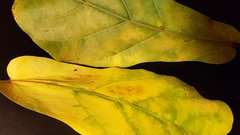

Kristina Burr
7 years agoHi guys!
a question about my fiddle. He is about 5 ft tall, and is also planted with a smaller fiddle, about 3 feet tall. They were growing so so beautifully, sprouting new leaves left and right. And then...we moved. They get much less light now. 8 months later, the smaller tree is sprouting his first little leaf. But the big tree--nothing at all. Actually has lost about 5 leaves (yellowed and fell).
I looked at at the roots, and noticed that the side with the big tree aren't growing much, they seem to be brown and dry. I didn't know what to do. I loosened up the root ball, cut off a bit of the brown dry roots, and put it in a smaller pot. Then watered (2 L filtered room temp) and fertilized (osmocote slow release). Also cleaned the leaves.what is up with those roots? I'm just using regular organic soil. I love my tree. Please help:(
tapla (mid-Michigan, USDA z5b-6a)
7 years agoMoved from where to where? Many trees, including Ficus, respond to significant reduction of light by shedding foliage. What is "regular organic soil". Depending on how you've been watering and what the level of TDS (roughly mineral salts) in the soil solution is, fertilizing might have been counterproductive. There just isn't enough information to offer meaningful help, but you should Find More Help Here.
Al
vibil18
7 years agolast modified: 7 years agoHello everyone
I have read most of the forum posts about ficus on this site. Four months ago, I bought a 6 foot high Ficus Lyrata. When I bought it, it already had several brown leaf. For 4 months, only 5 leaves have fallen.
I sprinkle it with 750ml of water every week. I also added 20-20-20 fertilizer once too week ago.
On the other hand, I have the impression that my Ficus is not healthy and has some difficulty. I think I noticed new brown spot on my leaf. Also, 5 new leaves appear since I but, one of them have some small red dot on in. I wonder what I should do to keep my ficus healthy. I am open to all your advice because I would really like to achieve something beautiful.
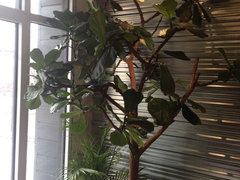
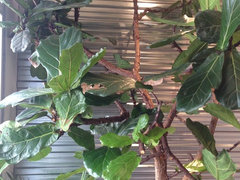
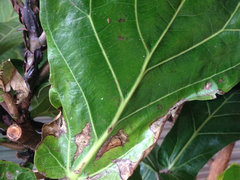
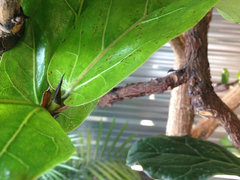
Dave
7 years agoI'd say it's been over watered. Watering an exact amount weekly is a good way to over water.
Water as the plant needs it, not on a set schedule.
20-20-20 is not a good one for these. Something like 9-3-6 or 12-8-24 is what you need.
I remmeber this tree from your other thread.
That pot looks large. Does it have a drain hole?
tapla (mid-Michigan, USDA z5b-6a)
7 years agoDid you mean to say 9-3-6, 24-8-16, or even 12-4-8, Dave?
Al
Dave
7 years agolast modified: 7 years agoAl, typo, ha. I mixed 12-4-8 and 24-8-16 together. I don't use those anymore as I use FP 9-3-6 for all of my plants.
But yes, that's exactly what I meant.
vibil18
7 years agoYeah, I drill a drain hole at the base of the pot. The pot is very large, so I was thinking that only 750ml of water is not a sufficient quantity to over-watered. I will try to reduce the quantity, and only wattering when the soil is dry.
Dave
7 years agolast modified: 7 years agoUse a sharpened wooden dowel stuck all the way in the soil to the bottom to tell if you need to water or not.
Stick it in and pull it out right away. If it's dark, damp and stained with soil, dont water.
Wait until it comes out clean and dry to water.
Don't reduce the quality, water throughly so water exits the drainholes, but discard any collected water in the saucer so the plant doesn't suck it back up.
i suspect your issue is too large of a pot with a soil that too water retentive and it's simply never drying out.
did you put it in that pot or was it like that when you bought it?
until you get it out of that pot and into a smaller one with a much faster draining mix, the tree will likely keep declining.
Speaking of that, what soil mix is the tree in?
vibil18
7 years agolast modified: 7 years agoFirst of all, I would like to say thank you Dave for taking your time to advise me well, it is really appreciated.
I buy the plant in this pot and I have not changed the soil since I bought it.
Maybe I should change to a smaller pot. I thought if I put it in a smaller one, the roots would not have enough space to grow. What size pot do you advise me? I can also replace the soil of the plant, but I do not know what is the most appropriate soil mix.Lauren
7 years agolast modified: 7 years ago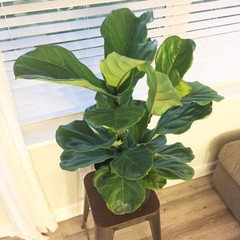
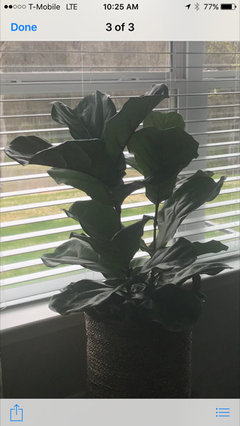
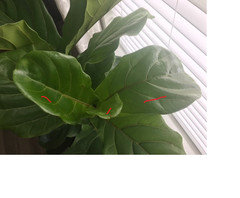
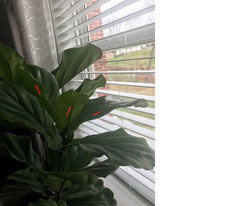
Hello! Looking for a little help with my Fiddle Leaf! My fiance picked one up for me the other day at a local nursery in Nashville. Its probably 2.5-3 feet currently. The people at the nursery showed him the "momma" and she was about 10 feet tall. They said mine would be around 8 foot tall. I placed "sampson" in front of a big window in my apartment. Its east facing. I open the blinds every morning and leave them open until the sun goes down. The three newest leaves I noticed yesterday evening seem to be really soft and flimsy compared to the rest of the leaves that are firm and strong. One of the leaves that I'm talking about is a "baby".. its really small.. but the other two leaves are just as big as the rest of the leaves on the plant. I'm concerned that this might be a sign of over or under watering or maybe too much direct sunlight in the morning? Any thoughts? Nothing is turning brown. The three leaves might have a hint of yellow to them.. but I think thats because they are so new.. not sure though. We have not repotted the plant yet-- its still in the original pot, we just put a basket over it to cover the plastic black pot :) The pictures above in order are--
The day we brought it home
Today ( usually there is more sunlight-- its rainy today)
Above view of the three leaves I'm talking about. I've marked the leaves in question with red :)
Side view of those three leaves
The three leaves that are worrying me-- the one on the right seems to be drooping down quite a bit.
Also-- is the curling of the edge of the leaves normal? The big healthy leaves have a curve at the very edge of them-- just wondering!
Any help is greatly appreciated!
Dave
7 years agoYoung leaves won't be as thick and leathery as the older ones until they mature.
They cant say for sure how tall your tree will get. It'll grow as tall as the conditions you provide will allow it.
Take a look through this thread to understand your tree better:
http://forums2.gardenweb.com/discussions/1476078/ficus-trees-in-containers-iv?n=223
While you're at it, have a look at this thread as well:
http://forums2.gardenweb.com/discussions/2842847/container-soils-water-movement-and-retention?n=8

Cindy Tong
6 years agoI have two ficus leaves plant....
First I live in Malaysia tropical country with humid and hot weather. I am a beginner in gardening so really hope you guys can help me out here...
first one I got from Ikea and second one from a nursery. I place it in a corner of my living hall where not much sun get through it unless if i open up my curtains...At first the soil were alway wet and hence i let it dry out....after that i think it dry out too much..but i notice that the leave turn yellow and brown..so after asking some fren the recomend me to change the soil to a less compact one to let the water completely drain out ...and hence I did, I change to about 40% burned soil (meant for cactus )and remaining with the normal dark brown sand meant for leaves plant. and this time I notice when I water the water drains out.....but after few days the leaves continue to turn yellow and falll....I ask my friend again he recommend me to bring to nursery to rebalance the soil...I wonder if this is the only way or there's other thing I can do about it?
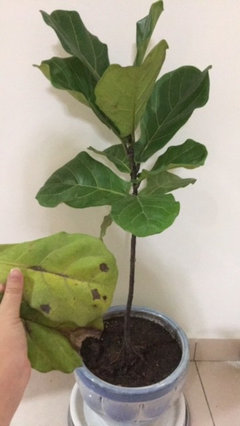
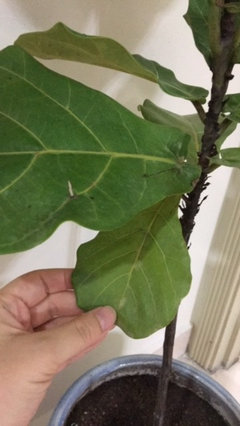
some of the leaves also have black spot. but when I got it frm ikea those black spot were there already but now grow more close to each other and bigger
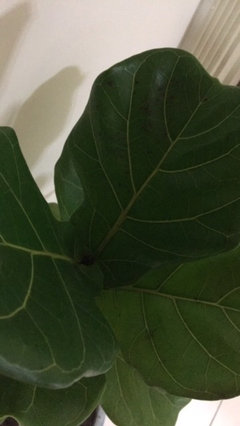
and then the second ficus tree is from a nursery..this one is quite huge..when i got it the leave look healthy but there is some brown spot here and there....i place it in my study room where it's quite near window but sunlight doesn't comes in until i open up the curtain tooo....i plan to open up the curtain later to let it get some sun...i have change the soil with the same way I did for the smaller ficus i got from ikea....i water it a week 6 days ago and today jus realize the soil kind of dries out so i rewater it again until water drains out from the soil....as of today one leave turn yellow and curled up...I am so sad to see it that way...
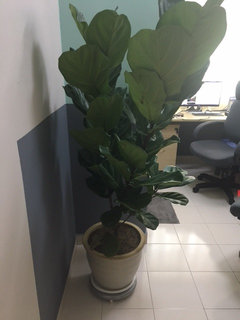
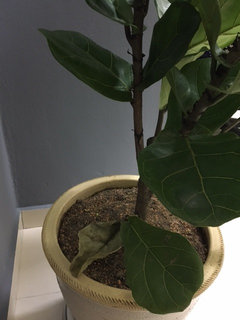
and as I were typing the leaves fall again.....
can i know if I were underwatering it or was it lack of sun?any idea to save my tree???:(
also i read in this thread that we need to pour away the water drains out on the sauce to avoid water going back in...but the ficus I have is so huge and heavy it will be hard for me to lift it up.....i wonder if i use a cloth to absorb all the excess water will work the same?tapla (mid-Michigan, USDA z5b-6a)
6 years agoIt takes some time to react to conditions that approach the limits of what it's programmed to tolerate. In this case, it sounds like either a reduction in the amount of light the tree is adjusted to, or a watering issue are the most likely suspects. Unfortunately, the recovery period is even longer than the time it takes the tree to react to negative cultural conditions, so be patient.
The plant doesn't tolerate over-watering well - especially if your soil supports a soggy layer of saturated soil near the bottom of the pot, so please start using a wooden dowel rod (sharpen in a pencil sharpener) or a bamboo skewer as a 'tell'. Inserted deep into the soil, it will be able to 'tell' you if the soil still holds moisture. If checking regularly, water when the tell comes out dry.
Also, your plant needs very bright light for at least 8 hours every day to do as well as it can, so work toward that end, too.
Finally, your tree needs regular fertilizing with an appropriate fertilizer. You cannot neglect supplementing nutrition and expect the plant to do well. It won't.
If you raise your plant above the saucer by putting blocking under the pot, the effluent cant make it's way back into the pot. If the water doesn't all evaporate between waterings, you can suction it from the collection saucer with a turkey baster.
AlCindy Tong
6 years agoMay i know what type of fertilizer suitable for this type of tree?
i will try to open my curtain to let the sun shine through the window..
thanks for you advise i will try to insert the wood to see if soil is dry and water accordingly.
tapla (mid-Michigan, USDA z5b-6a)
6 years agoI'm not sure what you have available there, or how fertilizer %s are reported on the container. In the US, the container shows the actual amount of N, but show the % (by weight) of P2O5 and K2O instead of P and K. If your fertilizer packaging DOES NOT report P and K in the same way, look for a fertilizer that has about 6x as much N as P and about 3/5 as much K as N.
I heartily suggest a fertilizer, the NPK %s of which can be reduced to a ratio of 3:1:2. The fertilizer I use (Foliage-Pro 9-3-6) fits that bill, but so do other fertilizers regularly available in the US, like 24-8-16 and 12-4-8. The RATIO of your fertilizer is especially important when you can't or aren't regularly flushing your soil as you water. If your fertilizer's ratio doesn't closely mimic that at which the plant actually uses the nutrients, it's a sure bet that the ratio in the soil solution will very quickly become seriously skewed and leave you with a number of nutritionally-related issues to deal with.
Al
Cindy Tong
6 years agoOne more question how frequent shall i put on the fertilizer and how much each time?
tapla (mid-Michigan, USDA z5b-6a)
6 years agoYour watering habits dictate how often and at what solution strength you should fertilize. Implementing a healthy supplementation program is very easy if you're using a soil that allows you to water to beyond the saturation point, so you're flushing the soil each time you water, but not at all easy if you're forced to water in sips in order that you might prevent issues associated with prolonged periods of soil saturation. Need more info re how you water.
Al
Cindy Tong
6 years ago
This is the fertilizer i have at my home...it show npk % instead of ratio...not sure this can be use...
i follow all ur advise ..i place it near the window to catch some sublight and poke a wood stick to check if soil dry if dry i iwll water u till some water drains out at the sauce then ill stop...now the small one seem to hv new leave growing out...the big one had some new pointy brown leave (new leave ) to grow soon i guess and bottom leave doesnt turn yellow for now..i hv not put any fertilizer yet...please advise if i can use this fertilizer or should get another type!robin98
6 years agoThat fertiliser looks better for your garden, it may be more of a soil amendment too, with various organic materials in it which is not what you’re after for an indoor potted plant. See what else you can get in your local stores or online.
Cindy Tong
6 years agoAlright i will try to look for another fertilizer...
@littlebuggy the nok number is stated in the pic...u hv to click the pic to see it...litterbuggy (z7b, Utah)
6 years agoThanks, Cindy. I saw that, but I hoped the percentage for each element was listed on the back of the bag.

Penelope Rose
6 years agoHey everyone ! So I need some help . I got this ficus lyrata bush about 2-3 weeks ago and it was perfectly green when I got it from homedepot . After a week I noticed some leafs turning brown on the edges and a bunch of tiny brown spots starting showing on the leafs . It gets a good amount of sunlight without being directly on it . I watered it maybe 1s a week when I top is dry but I don't think that's working too well . Only the bottoms leaves are turning brown . And one leaf towards the top starting curling . If I'm over watering it should I let the soul completely dry out before watering it again ? Should I remove the leaves on the bottom that are turning brown ? How can I tell if I'm over watering or under watering ?
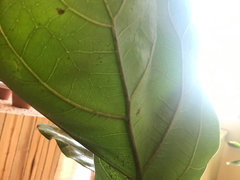
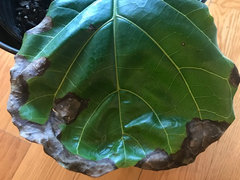
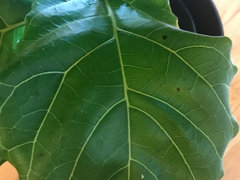
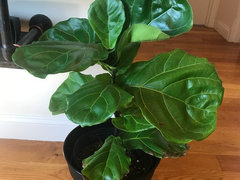
litterbuggy (z7b, Utah)
6 years agoCheck out tapla's post on October 21st for soil moisture monitoring method. Leave the damaged leaves, at least until the roots have recovered some, because they'll provide the energy the plant needs to grow new ones. In general a plant will drop leaves that require more energy than they manufacture, so it's best to leave them unless they have a disease that might spread--or, if they drive you crazy, until the plant is healthy enough that losing one or two won't be harmful.
Cindy Tong
6 years agoSo i have been following the watering advise...but i still see some bro n spot on my leaves...i hv not put any fertilizer yet as trying to find time to go get the fertilizer (its far frm home). So it is lack of nutrition or still under watering?i gave it a good sunlight through my enclosed window...
and today for some reason a fully green leave fell off...not sure what really causes it but i do hit on it sometime when i pass by the alley where the tree is placed...the cut frm the leave steam is a pretty sharp and clean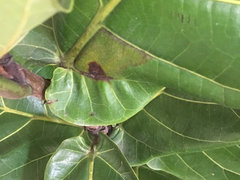
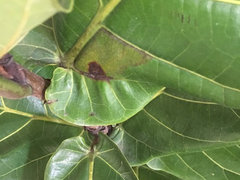
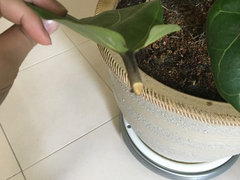
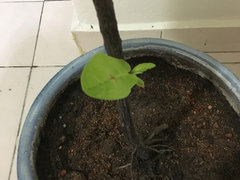
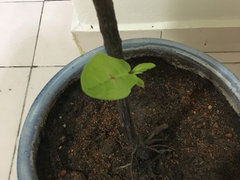
And my another plant is doing ok but the new grow has this dark red spot..is it normal?
thank you in advance for thfor advices!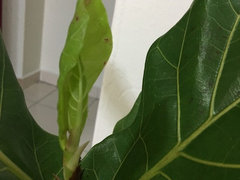
Cindy Tong
6 years agoSo i have been following the watering advise...but i still see some bro n spot on my leaves...i hv not put any fertilizer yet as trying to find time to go get the fertilizer (its far frm home). So it is lack of nutrition or still under watering?i gave it a good sunlight through my enclosed window...
and today for some reason a fully green leave fell off...not sure what really causes it but i do hit on it sometime when i pass by the alley where the tree is placed...the cut frm the leave steam is a pretty sharp and clean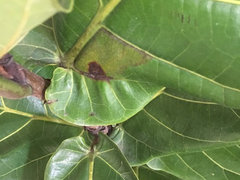
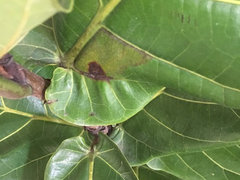
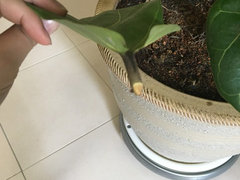
And my another plant is doing ok but the new grow has this dark red spot..is it normal?
thank you in advance for thfor advices!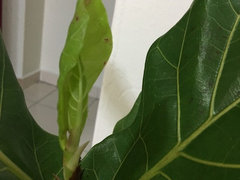
Cindy Tong
6 years agoanother of a fully green leaf just drop...really need advise what causes it?lack of nutrient or pot too small?underwatering?
litterbuggy (z7b, Utah)
6 years agolast modified: 6 years agoI'm just bumping in case someone who's better at this can venture a guess.
Just in case, has your dowel come out dry yet? If not, how wet/damp is it?
Cindy Tong
6 years agoLeaves still dropping at one pc per day...im letting the soil to dry out now without watering...i put goat fertilizer(the one that mimic the ratio suggested most) on top but it doesnt dissolve in yet cos i did not water it...
and someone told me to put electric light source it will help..somesay this tree not meant for indoor ask me to place outside..so im trying out the lighting n let soil dry for 2/3days if no improveent then ill put it out..









tapla (mid-Michigan, USDA z5b-6a)