





In the ground
Wondering how much better plants would do if they were allowed to grow in the ground all summer instead of a pot. Any time I put a piece of something in the ground, the difference is amazing. Wonder if just burying the pots in the ground would make a similar difference. What do you think about it?
Comments (96)

teengardener1888
10 years agolast modified: 9 years agoHi everyone, that is a striking bougainvillea. I wish to have one one day but that day is simply not today. Bougainvilleas are difficult to grow north of the mason-dixon line and I have no greenhouse. Then again, its worth a try
Delrey, enjoying summer vacay
Related Professionals
Derry Landscape Architects & Landscape Designers · Berkeley Heights Landscape Contractors · Cerritos Landscape Contractors · Forest Hills Landscape Contractors · Lakewood Landscape Contractors · Melrose Landscape Contractors · Nutley Landscape Contractors · Pacifica Landscape Contractors · Rockland Landscape Contractors · South Farmingdale Landscape Contractors · Southbury Landscape Contractors · Vallejo Landscape Contractors · York Landscape Contractors · Bloomingdale Interior Designers & Decorators · Washington Interior Designers & DecoratorsTiffany, purpleinopp Z8b Opp, AL
Original Author10 years agoToni, that happened yesterday, I almost ran face-first into a big banana spider. It did need to be moved from the back porch, no matter how hard he/she had worked on that cool web, which was all over me. DH heard me yell so he was there to do the relocation but I would have done it if home alone. I'm lovin' that waffle too. Had a non-varieg one for years that I put in a bad spot and forgot about a few winters ago. It's not THAT xeric, oops! I'm not sure those are Petunias. Are you?
Sugi, sweet, but you tease! Your Boug rocks (as does the rest of your incredible collection!!) Nothing I can do about the weather but continue cursing at it (lately.)
Delrey, if Boug props easily from cuttings, I'd be happy to send some for postage. Vicarious satisfaction would be better than none, assuming you'd do great with it! It had beautiful fuchsia flowers when I got it (of course - why else would I succumb to such a ridiculous whimsy?) Didn't mean to, but accidentally glanced at it yesterday, no sign of anything but new leaves forming. Glad you like the PS. It doesn't travel well, but has been known to survive. I'd be happy to stick a few pieces of that in too, there are several around the yard.
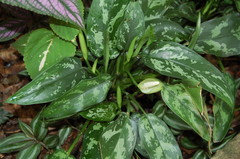
The Aglaonema I pictured 7/1/13 is definitely going to make some flowers. Now I can see 4 (but only managed to get 3 in this pic.) They are slooooowwwww but that's true of everything this summer, all rain, NO sun.
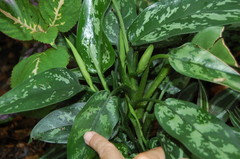
Tiffany, purpleinopp Z8b Opp, AL
Original Author10 years agoJust remembered I took 2 other pics for this earlier.
Sans 'Moonshine' has made a pup.
{{gwi:111059}}
Love this spot!!!
{{gwi:111060}}
birdsnblooms
10 years agolast modified: 9 years agoMorning All,
Delray, noticed you planted Musa Basjoo. They're beautiful and quite hardy.
Planted a basjoo in the back yard. It survived z5 cold winters...that is until winter 2012.
2012 was the coldest winter I remember. Not only did my Musa die but I lost a few perennials, too.
Since you're in z6, and if your winters aren't 5F for several months, your non-edible banana should do great...You asked where you can find Bougainvillea. Are you talking about a locally or an online nursery?
Walmart had 3-4-foot, staked Bougs, for 19.99. (last year)
In either Aug or Sept, those that didn't sell, '30-40' were marked down to 4.00!!Every so often, Home Depot has Bougs. A local nursery, Ted's in Tinley Park, sells Bougs, too.
I don't know your location, but you said we're close. Are you in IL or another state? If you'd rather not say, I understand.My last Boug was purchased from an old hardware store, Handy Andy's, in the early 90's. Raspberry Ice. Had it several years..One summer, we needed a new roof. The men tossed old roofing material on my plants..My Boug and a few other plants, including the first rose I'd planted, Abe Lincoln, were buried under several layers of roofing tiles and rusty nails.
If you want to buy online, 'Accents for Home and Garden' has Bougs. 5.95 in 4" pots.
'Almost Eden Plants' has RI, 6.99.Purple. Banana Spider! On your front porch? You almost ran into it? OMG!!!
Aren't they poisonous? How did your dh relocate? W/bare hands? Oh Lord!
My stomach is grumbling. B/P just increased, P, probably 150 bpm.
Don't know which is worse. Your Banana Spider or Rhizo's Black Widow.Okay, 10-deep breaths. The one and only reason I don't care for summer. Darn bugs!
Your Aglao is doing great. Yes, Aglao flower buds are slow to open, but perhaps it's for the best. The longer they take to open, the longer you get to see, is it four?, buds. Then flowers and berries.
Do you know if your Aglao is 'Marie'?? Toni
teengardener1888
10 years agolast modified: 9 years agoPurple, is that Plechanthus'Mona Lavender' I see. I am also nursing one along
teengardener1888
10 years agolast modified: 9 years agoPurple, is that Plechanthus'Mona Lavender' I see. I am also nursing one along
Tiffany, purpleinopp Z8b Opp, AL
Original Author10 years agoToni, I gave up trying to name the Aglaonema. No way to be sure. It came from Costa farms 'plants of steel' but I just looked, they don't even list Ag in their plant library. Will post a pic when the flowers open.
DH used a broom to 'grab' the spider and take it to the trees along the back fence where we hardly ever go. We should have taken a pic of it, but there are a million pics of banana spiders out there already. They're really cool, look hand-painted. Just not on the porch, like you said. I'd love for it to eat bugs there, but its' web was preventing us from using the porch.
TG, yes that's Mona with the 'Rex Begonia vine' (actually Cissus discolor.) Got it in NOLA this spring. It's grown so fast, I've put cuttings in about a dozen places so far (saw your discussion, will get in on it, don't worry.) That plant doesn't mind the rainy/cloudy weather either. That spot gets some dappled light throughout the day, then some direct just before sunset.
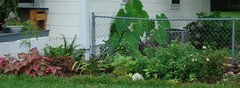
Here's an overall pic from part of front yard. Ferns in the corner, the bulb foliage next to that on the right is Amaryllis. Hardy here. TG, your mention of Amaryllis in another thread this morning made me think you might appreciate this shot. Also, where the ferns are in the corner is where that first avocado tree sprouted. Prob can't see it in this pic cuz I dumped a load of lawn trimmings in front of that spot before taking the pic. When I'm sure there's not still anything alive in that pile, I'll spread it out.
There's a brick edge there but DH claims the weed-wacker's broken. Hmmm...
teengardener1888
10 years agolast modified: 9 years agoI love armaryllis. I have 3 of them. Im jealous of your climate where you can experiment with certai houseplants surviving winter. Have you ever tried spider plants overwinter, they are hardy invasive monsters even in your area
Tiffany, purpleinopp Z8b Opp, AL
Original Author10 years agoYes, glad you brought that up, a definite no-no. My Mom did that. I had to dig it out, no fun at the base of a giant oak tree. Those carrot roots can go down a foot or more. It doubles in size in about a year and, after a few years, it had reached maximum capacity there, smothering a patch of wax Begonias. It took months to finally die enough to compost, in a big plastic tub.

teengardener1888
10 years agolast modified: 9 years agoOh my!!!!!!! I wish my spiders were so polific, You dont keep a variegated one as a patio plant, they are so beautiful
birdsnblooms
10 years agolast modified: 9 years agoAfternoon All,
Posted yesterday, but for some reason it didn't go through. Wonder if the problem is w/my provider or GW.
Purple. I didn't see your C. discolor while writing my last post. What a beautiful, beautiful vine!
I can grow Cissus w/o problems, but kill discolors.
Wonder if it's a true Cissus..Another name is Begonia Vine, or some such name, but Begonia is definately a the 'common?' name.I like the way your garden is setup.
Is the hanging plant, to the right, a Philo?I believe your Aglao is 'Marie.' But, guess it doesn't matter since most Aglao's have the same care requirements.
Wish my Aglao looked as nice as yours.Ag's are difficult keeping full/compact. At least my experieces. A couple weeks ago, I potted most green Aglo's in one container. Think I'll do the same w/pinks next. Saves on space, too.
The Black Widow. Urp!
Before relocating a poisonous or non-poisonous spider, I'd don the thickest, winter gloves, grab one of dh's size 10 shoes, then SPLAT!
I don't like killing bugs, truely, but there's no other choice. I'd never harm a butterfly, ladybug, etc.
With my luck, even if I had the ba$$s to relocate, it'd find its way back here.I'll probably pay for it in another life. :)
I also like the view of your garden. Those pink flowers, Caladiums? are gorgeous.
Is the large-leaf plant an Elephant's Ears? What's the tall plant to the right?
Spider plants made great ground covers..I'd rather have Chloro's than boring grass. Toni
Hope this post goes through today.Tiffany, purpleinopp Z8b Opp, AL
Original Author10 years ago"I like the way your garden is setup." Thanks!
"Is the hanging plant, to the right, a Philo?" Yes ;)"Those pink flowers, Caladiums?"Yes "...are gorgeous." Thanks, I think so too!!
"Is the large-leaf plant an Elephant's Ears?" Yes, Colocasia esculenta, from a bin bulb from Lowe's over a decade ago.
"What's the tall plant to the right?" On the other side of the A/C box? Hydrangea. If you meant in front of the fence, it's Lantana camara on the left and knockout rose on the right, bumping into one big glob. That Lantana is a cutting that's supposed to go to DH's Mom's house. It needs to do that soon.
"Spider plants made great ground covers" Indeed, it will cover the ground.
"I'd rather have Chloro's than boring grass." If it wasn't a perfect hiding spot for snakes, I'd feel the same way. Three poisonous snakes have already been killed in Mom's yard. I think you would like our lawn though. It's full of tiny flowers.Here's some things that are struggling from the weird weather, too much rain. Alocasia 'African mask' with some Sedum. The portulaca pilosa seems OK with it so far.
{{gwi:111061}}delreytropical
10 years agolast modified: 9 years agoPurple dont know if you get this message in the other forums, but yes I would love to try some bougainvillea cuttings and pay for postage just let me know with details :)
Love your garden, very tropical looking for zone 8b well done.
And yes toni we are very close, im western suburbs of chicago, tinley park is a little far but Ive heard of Teds greenhouse.
Bougainvillea was not listed under the plants list they carry but I guess ill just have to go there someday and see.Ive been to many home depots around and cannot find a single bougainvillea. You would think with all this heat they would bring some in but who knows.
Back to purple: does your calocasia stay green year round or does it sprout back up every year ?
Tiffany, purpleinopp Z8b Opp, AL
Original Author10 years agoDelrey, sent you a private about the Boug. I used to see them up north around Mother's Day, FWIW.
This past winter the Colocasia kept sending up leaves that would get frost bite. Usually it's colder and it just goes completely dormant.
teengardener1888
10 years agolast modified: 9 years agoI would love to be able to grow cannaas and colocasia outdoors year roung. Purple, cherish your hot humid climate because up here, its hard to get tropical
birdsnblooms
10 years agolast modified: 9 years agoMorning, yawn, yawn...
Purple, thanks for your answers.
Wish you had a closup of Lantana and Hydrangea. Yes, I was talking about the hydrangea, right of the a/c.Too bad you can't keep a 'little' Lantana..it's such a nice plant, pretty, little, colorful blooms. A hummer's dream..well bee's, too..
' Poisonous snakes? Yuck. IL has poisonous water snakes, but don't think we have land crawlers. I hope not.
On one side of our house, TONS of Hosta grow. They're 8-10"-plus w/flowers. Anything can hide under those plants.I thought poisonous snakes lived outside US???
Purp, I have problems differentiating Sedum and Pachyveria? Too many sedums and pachys.
Portuulaca/Moss Rose,is usually sold here in baskets, but they make great ground covers, too. I consider them semi-succulent. Foliage is thick, notice?
Girl, I miss my younger days, before the gh. I used to sow various seeds, mostly annuals where the gh now sits. Moss Rose grew in the first/front row. Boo-hoo.Delrey. Ever hear of Brookfield Zoo. I'm here. If you don't mind me asking....are you west and/or north of the zoo.
How tall is your Musa? Come late autumn, hack down to 1', and mulch..Mulch and re-mulch.
Hope this winter isn't going to be as cold as last year!Planted my Musa summer 2010.
2012
Musa started with one, little plant. As of 2011, it increased to three. Summer of 2012, there were four, thick trunks. Height 15-18', depending on leaf.
Hope yours does as well...Toni
Tiffany, purpleinopp Z8b Opp, AL
Original Author10 years agoCool banana plant, I'm inspired!!! DH says we need some, I agree.
Toni, that little Portulaca is a petite cousin of moss roses, the flowers are tiny, pic below, smaller than a Tahitian bridal veil flower. Makes a great house plant, on the edge of hardiness here. I found it in a crack in the pavement across the street 2 years ago. I keep putting pieces in different pots to make sure I end up with tons eventually.
There are other Lantanas around the yard, I love them because they're always covered with butterflies, hummingbirds visit them often too, that's just not a big enough spot for one.
This is from a different plant, but here's a closeup
{{gwi:111064}}A different Hydrangea, but it did used to be a piece of the one by the A/C box until I propagated it and moved it here. Shown with Persian shield, Mirabilis jalapa (4'o'clocks,) and unfortunately none of the tiny pink flowers of Talinum paniculatum were open when I took this pic.
{{gwi:111065}}

delreytropical
10 years agolast modified: 9 years agoPurple our bougainvillea cuttings are on hold, I have a friend in San diego atm and they have found a bougainvilea!
Bangkok red is the variety ill attach a picture

Tiffany, purpleinopp Z8b Opp, AL
Original Author10 years agoThat's pretty, Del! Good luck with it!!
First Aglaonema flower opened. Looks like there's 5.
delreytropical
10 years agolast modified: 9 years agoHurrah! Wonderful it reminds me of anthuriums in a way. beautiful and congratulations on the achievement!
Tiffany, purpleinopp Z8b Opp, AL
Original Author10 years agoThanks! I didn't achieve anything though, I'm just an observer after putting them where *I* think they will be happy. Not all of them are so exuberant. Wish I had such power over plants! FWIW, it's been raining every day for about a month. This is one of the plants that likes that a lot.
birdsnblooms
10 years agolast modified: 9 years agoMorning All,
Purple...You should add a Musa or two.
I haven't checked, 'if you want me to just say the word,' but there might be edible Musas hardy to your zone.Purp, so you're saying your Portulaca is a smaller, flower variety than other Portulcacas/Moss Rose.
You said you put Port in different pots. Are they easily rooted and do they live indoors during winter?
I love Portulaca foliage and flowers.How tall is your Lantana?
Home Depot sells Lantana 'standards' trees. They're probably grafted..Don't think Lantana grows 4-5' or develops a 3-4' trunk..Do you?It's been a long time since I've sniffed Lantana..are flowers fragrant? Ohhh, hummers on your 'tana.
I don't know much about Hydrangea other than some are sold as gift plants, 'non-hardy, here,' and perennial Hydrangeas.
Which do you have?
Did you add something to soil to get blue flowers?Speaking of 4'o'clocks, I bought seeds this year. Varieties are not hardy in IL.
Mirabilis Stars and Stripes. Annual.
Miarbilis Marvel of Peru. Annual.Seeds were purchased too late in the season, so hopefully, they'll still be fertile next year.
4'o'clocks, 'no idea of type,' on south side of our house, were sowed from seed, mid-summer, years ago.
.10 packet sale.
I believe the packet said annual, too, yet they've been around for years. Oh, so fragrant. Semi-invasive, but nowhere near as invasive as Orange Trumpet Vine.
To think, I used to adore TV.Purp, of course I believe you, but flowers on your MR look the exact size sold here. But pics can be deceiving. Especially close-ups.
Purp, your Aglao seems to have more than 5 buds. Maybe I'm mistaken.
It's beautiful. Gotta love Aglaos.
You're tempting me to set my Aglaos outside :)Delrey, What a gorgeous Bougainvillea! Flowers are soooo red. Wow!
Are you planning on planting in-ground or keeping in container?
Do you know if it's evergreen or deciduous?I swear, you guys are plant-teasers. lol. Toni
delreytropical
10 years agolast modified: 9 years agoIm not sure yet, it may be a little late to try in the ground, maybe ill dig a hole for it to give it an "in-ground" appearance. You know the folks around chicago will be knocking on my door asking what is that
haha
Tiffany, purpleinopp Z8b Opp, AL
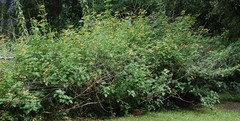
Original Author10 years agoToni, yes, Lantana can get taller than me. Below is Lantana camara along the fence. It's huge! I haven't trimmed the dead branches out for a couple years, shame on me! Kind of a gnarly tangle, but the wildlife doesn't care. Yes the flowers are fragrant, but not everybody thinks Lantana smells good, I do. Butterflies and hummingbirds really love it.
That portulaca is P. pilosa. It was only in 1 pot last winter and was inside. If winter had been a month longer, it might have been lost, didn't like the cold and low light at all (like most tropical succulents.) It's a cute little native that I think you have to just find, doubt it would be for sale anywhere (except online.) I've only ever seen it in cracks in the pavement of parking lots. Yes, it takes root wherever it touches the soil. That's how I was able to save some pieces from the bank across the street. I'd been wanting to grab it, and when a crew showed up to redo the pavement, I knew it was 'now or never.'
The Hydrangeas are old-school H. macrophylla, probably from before 'they' started messing with hybrids so much. Most of the plants around this neighborhood are decades old. I don't put anything in the soil to make the flowers blue, but some of the cuttings I took from the mama shrub are making pink flowers. I guess what they say about the PH being different a few feet away is so true. The proof is in the cuttings, which for sure all came from the same mama shrub with blue flowers.
birdsnblooms
10 years agolast modified: 9 years agoMorning All,
Delrey, if you plan on keeping your Boug in-ground year round, yes, it's too late. I'd wait until spring, 'whenever it arrives.'
BTW, is that type hardy here??? If so, I'm definately getting one. lol.Oh yes, I KNOW how ppl come to our doors here, asking what 'x' plant is or if they can have a cutting/seeds.
My garden isn't as well-kept as it used to be.
One year I bought and planted, red, orange and yellow, Crown Imperial Fritillaria bulbs.
They were beautiful and back then, costly. Flowers were amazing. I was so proud of those guys.One day I saw a man double-park in front; he was checking my garden. No biggie, right? The following morning I looked outside, didn't see any flowers. I stepped outside only to find 3 empty holes. I'm certain it was the same man.
Another time a neighbor asked for a few seed from my Giant Sunflower. I said, 'sure, help yourself. What he did was so unexpected. I 'assumed' he wanted a few seeds..Instead he cut off the entire flower head. lol.
Nowadays, my front garden has mostly, locally store-bought annuals and perennials. Although I did plant variegated Honeysuckle and variegated Mock Orange. Hope no one helps themselves to these newer plants.
Purple, unless you're 3' tall, lol, I wasn't aware Lantana grew as tall as a human.
Lantana sold here, 'unless grafted,' are fairly short. In fact, most, local, perennials get no larger than 3-4'.If you hadn't ID'd your bushy Lantana, I'd have no idea what it was.
BTW, I too enjoy their scent. Who wouldn't???So, your local Pilosa, roots when set atop soil? Like Kalanchoe.
You're right. Pilosa would need be ordered online. As a matter of fact, the day dh and I went garden plant shopping, I didn't see Moss Rose in pots or baskets.
Purp, don't take this the wrong way, but your story reminded me of a low-growing, shallow-rooted weed. This weed grows in soil but they're mostly seen in sidewalk cracks, too. They spread wide.
Your soil must be acidic. My old, hardy Hydrangea, 'sowed from seed,' had white flowers in fall.
I read, lowering pH will produce blue flowers and raising pH will produce pink or white flowers. Guess our back yard soil is alkaline.Is foliage on your Hydrange thick or thin? My Hy had semi-thick foliage. Succulent-like.
Hydrangeas sold in stores have paper-thin leaves. Definately not hardy. Lately, most I've seen are either blue or pink. I thought, like so many other plants, flowers were painted.Years ago I bought an established 'Hydrangea,' from a non-reliable nursery in IL. This nursery has a ton of Negative feedback on GarenWatchdog.
The nursery sends sticks that look dead. lol. But, they're not dead..I believe they're dormant.
After planted in the garden, plants grow some foliage. The following year, one wouldn't believe it's the same plant.According to feedback on GWD, many people give negatives because this nursery sent the wrong plant.
Anyway, I ordered another Hydrangea, 'don't know variety,' many moons ago. It grew, was quite full, but never bloomed. Ever.
All it did was grow tall, taller, tallest.
In fact, one year my indoor plants were whie-fly infested, I discovered Hydrangea was the host.
This year we dug up that Hydrangea. It was a boring plant. lol.I still find it amazing your Hy's have blue flowers. Toni

asleep_in_the_garden
10 years agolast modified: 9 years agoFINALLY I can add something here! LOL
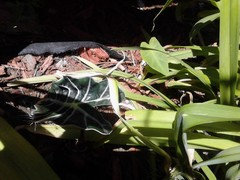
...Just wish the pics were taken a little better(sun obscured the view-thingy).
delreytropical
10 years agolast modified: 9 years agoWow thanks so much asleep, I love the alocasia in the second pic, I think I have the same variety, it seemed to take a while to leaf out, just around early july for me. :)
Tiffany, purpleinopp Z8b Opp, AL
Original Author10 years agoNice! I'm not alone, whew! Those are fantastic leaves, Asleep. How long have they been in the ground?
If I had any inkling it would rain almost every day for 6 weeks, I never would have put these plants in the ground. Most of them haven't died yet, but there's been hardly any growth at all except the Kalanchoe in the middle near the bottom of the pic. I've taken cuttings from it 3 times already although it started as a cutting itself at the first of April. And if that's hardy here, it's a huge mistake putting it there. Every little tiny green bit at the base of these plants is a baby Kalanchoe. Hope they're easy to pull.
I try to keep the leaves picked out of the area, but it's getting tedious. I think I'm about ready to dig these back up.
{{gwi:111066}}This little Adromischus does have a flower stalk, so it's not all bad.
{{gwi:111067}}birdsnblooms
10 years agolast modified: 9 years agoMorning,
Asleep, what do you do with Alocasias in winter?
Wrap them up in the dark or keep potted?The first Alo, 'African Mask' blooms in fall and winter. At least in pots, don't know about in-ground.. Or repotting in a container after being in-ground.
In pic one, what are the blade-like plants?
My favorite Alo is one I can't grow..Of course, I can't think of the name off hand...lol. It has arrow foliage.
Purp...If Kalanchoe is hardy where you live, as it's common name describes, you will have Mother of Thousands/Millions. lol.
Since Kal leaves drop in nearby containers, by spring they're big plants, ready to be in a pot of their own. However, I sure don't want duplicates.
Like you, I planted several in-ground, but since they're not hardy here, they'll either freeze or if I bother transplanting in a pot, by mid-winter they'll send out tall, orange flowers..yet another duplicte plant.If by chance they are invastive, young Kals have shallow roots..so fairly easy to lift. Toni
asleep_in_the_garden
10 years agolast modified: 9 years agoDelreytropical,
Thank YOU! :)
I've always assumed that it is a macrorhiza even though the leaves aren't always totally upright. I got it from a neighbor's yard when I was still down south. I'd remarked on it's beauty and the lady said "oh that thing?"..and went on to tell me that her husband was gonna hit it with the mower when he got home! At that point I asked her for a shovel. :DPurp,
I popped those guys in the front bed in early spring(which was likely still too cold)and a few of them are actually still frikkin dormant! :/
Toni,
Typically I allow the alocasias to remain in their pots over the winter and eventually go dormant. It's sad to see them go to sleep but then I think about the space they's be taking up if they didn't and then I don't feel so bad! Now I'm not sure if I should pot the ones in the ground before taking them in. Storing them bare kinda makes me nervous though I don't know why it should.. Acquired the african mask this spring and maybe I'll see bloom eventually but right now I kinda doubt it...I'm terrible with these and my whole purpose in putting them in-ground was a desperate ploy at growing them right. I have a history of killing them in containers.
Edit: Sorry Toni,forgot to mention that the leaves you asked about are daylilies.
...Here's a pic of the front bed.
This post was edited by asleep_in_the_garden on Fri, Aug 9, 13 at 11:55
asleep_in_the_garden
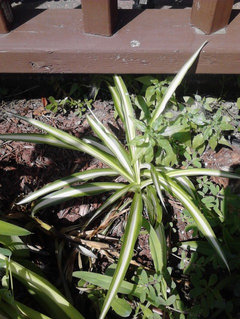
10 years agolast modified: 9 years agoAlso some time back I spoke about putting a spider baby out front in the bed,and how it fried to nothing...then eventually came back from the roots.
This is what it's looking like now. :)
birdsnblooms
10 years agolast modified: 9 years agoMorning,
Purple, forgot to mention your succulent, Andro. They're so cute.
I have one that's been in a 'sort-of' dish garden. If it's flowered I missed it. Love their pouchy leaves, too.
Your Andro is so full.Hey Asleep. So, in other words, you place Alocasias in a dark room, and refrain from watering?
I'd be afraid, too. lol.My AM is old, has ONE leaf. The bulb/corm is firm, so it's not dead..just not doing anything.
If it wasn't for ants, it would have been summered outside.
Alo is kept in the upstairs bathroom, on the toilet tank,, lol, adjacent a west window..I know it's not getting enough light which is probably the reason there's one leaf.This summer we bought a few annuals..Dh chose a plant that was tagged, flowering kale. Anyway, he said, let's get this plant.
After we left, I asked why he chose Alocasia. He said, I didn't pick an Alo, I bought Flowering Kale. I said, 'dh, that's not kale.' lol.
There's way too many Alocasias and Colocasias to ID.If I decide to save the bulb/corm for next year, when do I dig up? It's in an outdoor container, so it'll have to be lifted.
Definately not hardy. Also, I wonder if it should be stored in the basement w/Dahlias....Bare-root, no water, dark.Hey, don't blame yourself. African Mask are difficult plants.
Don't give up.Beautiful Daylilies! They're sure getting enough sun.
Your first Lily, in the back, looks huge....???Aw, your Spider is looking-good. Bet your were surprised finding a plant you thought dead! It looks terrific now.
Did you ever go to GReat America?
In different sections of the park are large, 'ornate,' containers w/huge Spider Plants..Spiders live in full sun, yet, they thrive beautifully. So many babies, too.
I never figured how they got Spiders to live in direct sun w/o brown tips/leaves.Toni
asleep_in_the_garden
10 years agolast modified: 9 years agoHi Toni!
The AMs were in the ground when I first laid eyes on them and soon were moved to containers. Since then it's been hit and miss but when I put them in the garden bed they come back in force...provided they wake up(still have a few that are sleeping even now). When winter approaches I move them to containers where they are allowed to go dormant when they feel like it...which is shortly after I start cutting back on the watering,and after that I let things get pretty dry in there till spring. I'd just dig yours up and pop it in a suitable sized pot and then bring it in once things get too chilly to be outside...so far this is what's working for me.
The spider had been thrust into the full morning sun without any to adjust at all so although I wasn't the least surprised that it fried,I honestly would have been really shocked if nothing came back from those healthy roots that I knew were running wild and loving life.
Really appreciate the pep talk where the african mask is concerned,so far so good...in fact I'm getting a new leaf at the moment(I'll have to get more pics of it tomorrow)and I can't wait to see it open! I just KNOW it's going to be even more spectacular than it's predecessor. I'm pretty jazzed to say the least.
Those daylilies are survivors of and escapees from captivity that I found in a ditch under too much canopy for them to have really been happy so I took 'em home where they could get their fill of sun,..and yeah you're right,..a few are getting pretty big alright! Thanks much for the compliments by the way,I am kinda proud of my greenkids.
Here's a look at one of the smaller AMs that's in a pot in the shade of the maple in back and getting nowhere near the sun that it's clone is getting up front.

asleep_in_the_garden
10 years agolast modified: 9 years agoThe one in full sun is looking like this...
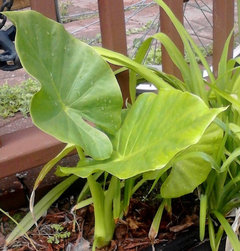
Tiffany, purpleinopp Z8b Opp, AL
Original Author10 years agoThis has turned out to be an awful spot for these poor succulents. Under water again yesterday. It didn't really come out in the pic, but there's water standing in this whole area.
(And so far, no sprouts on the bulbs. They might just be dormant, they say sometimes you have to wait a while for bulbs to recover after being moved. Really hoping these like the added sunshine (and, of course, rain) from being outside.) ...no, really, sorry, they're on their way to be "disposed of properly."
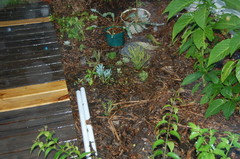
asleep_in_the_garden
10 years agolast modified: 9 years agoI'd move 'em to higher ground myself. Maybe after sitting 'em on newspaper to dry 'em out a bit first,but I know you know what you're doin Purp. :)
Spent my whole life in the south and miss it terribly sometimes. So jealous of the extended summer you'll have by comparison,but at least it could give the ummm...potential compost a fighting chance? No? Too late?
Tiffany, purpleinopp Z8b Opp, AL
Original Author10 years agoNo, you're right, that was the last straw. Everything that was there looks like it can recover but I did dig everything out. Clearly this weather pattern isn't going to change, only get worse from what they're saying now. I've seen water puddle up in the yard at some time every year I've lived here, but never in some of these places at all before this year, and so much deeper in the usual low spots.
This spot below was doing so well until our dog walked through it a couple weeks ago. It's gotten drowned so many times since then, stuff wasn't recovering, and some rotting. I took cuttings of most of what was left yesterday, from the struggling plants, mostly the Begonias. Stuck them in the higher, dryer ground of pots. Oh irony, how I love you. Luckily the pretty vine seems quite happy with everything, it's on kind of a bump, so never under water. Other spots and plants seem to be coping OK. This has been a totally new challenge this year, after decades of ground/potted growing. Everything to the right of the support thing is under water, an inch or more.

asleep_in_the_garden
10 years agolast modified: 9 years agoHappy to hear you got 'em out.
Maybe some nice marginals in their place? ...Fancy cyperus?
asleep_in_the_garden
10 years agolast modified: 9 years agoBack when things were just warming up and minnesota finally elected to relinquish winter,I put this tiny bit of ficus pumila in the dirt back behind the waterfeature.
The leaves are noticeably tougher than the pampered ones indoors in their various humidity traps.
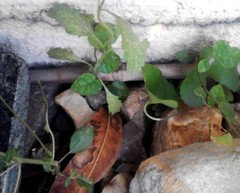
asleep_in_the_garden
10 years agolast modified: 9 years agoSpider experiment looks like it was productive!
And to think it was burned to the ground earlier in the spring. Wow...way to recover!
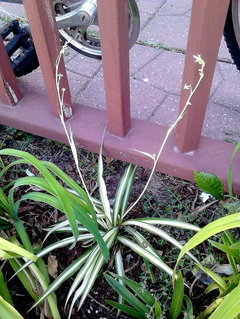
asleep_in_the_garden
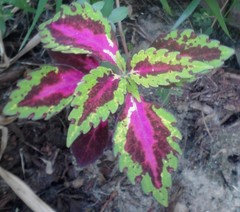
10 years agolast modified: 9 years agoAfter the overexposure to the sun and likewise being burned down,..this is all I have to show for coleus this year. LOL
asleep_in_the_garden
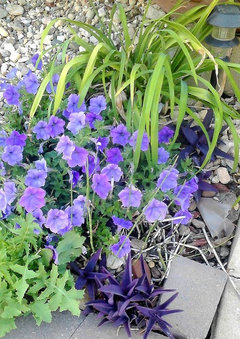
10 years agolast modified: 9 years agoThe trad that was still holding the ground when I took mama pot and all to the back actually looks a little better than the ones that went to the west side for the summer...maybe they like morning sun better?
Tiffany, purpleinopp Z8b Opp, AL
Original Author10 years agoLove the colors in the above pic!
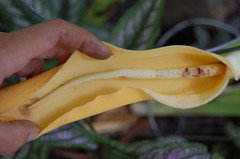
Elephant ear (Colocasia esculenta) has made a flower!
asleep_in_the_garden
10 years agolast modified: 9 years agoThank you Purp,
...kinda thought you'd appreciate all the purple in that shot! :)
I see your magical money producing EE has been harvested since the last photo of it.
Hope you didn't spend it all in one place! ;)
Tiffany, purpleinopp Z8b Opp, AL
Original Author10 years agoHere's some pots of plants excavated from the ground to huddle inside while it's too cold. Then back outside in the spring! Sorry the pics are small, Imageshack is doing that. Maybe you can get a bigger version clicking on them, I can't figure it out. I thought there were too many pics for individual posts...
Begonias, Hemigraphis, the Tradescantia pallida is hardy but the above-ground parts are lost to frost. Might as well start new plants with them over winter.
{{gwi:111072}}Sans, more Begonia, Tradescantia, ZZ, Callisia fragrans:
{{gwi:111073}}Begonia, Aglaonema, misc cuttings.
{{gwi:111074}}Rex Begonia vine cuttings put in water for a few weeks until roots appeared, Brugmansia cutting, Tradescantia 'Red Hill.'
{{gwi:111076}}The 2 pots on the left are from a recent trade but the pot on the right is excavated ground plants, Sans, Coleus, Callisia fragrans, another Begonia.
{{gwi:111078}}Plectranthus 'Mona Lavender' with Tradescantia cuttings.
{{gwi:111080}}Couple of Aglaonemas, Begonias.
{{gwi:111082}}More Ags and Tradescantia. These 2 Ags are losing some leaves over this, the hardest adjustment (apparent so far) of any of them. I left the soon-to-be-lost leaves on, on purpose. These were desperately thirsty when I dug them up, that probably didn't help.
{{gwi:111083}}




Tiffany, purpleinopp Z8b Opp, ALOriginal Author