




|
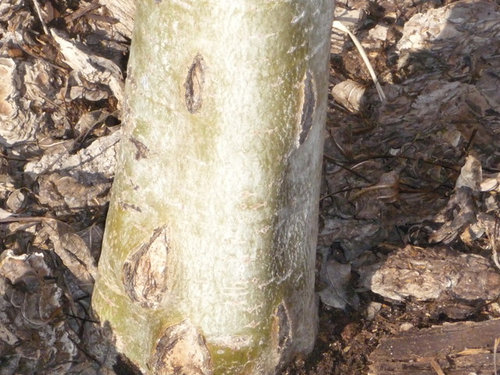
| Attached is a photo of our Quaker tree that is approximately 5 years old and is currently dormant. The base of the tree is about 5 inches in diameter and is about 12 -13 feet tall. The bark is splitting near the base and we were wondering if this is normal. We are hoping that it is not fungus and just sunscald. We spray with dormant oil several times during the winter because we did see some rust spots a couple of years ago on the leaves early in the fall just prior to the leaves dropping. Please advise on a course of action and thanks for your time. |
Follow-Up Postings:
|
- Posted by ken_adrian z5 (My Page) on Tue, Feb 19, 13 at 13:16
| i dont see the root flare .... but that might just be mulch ... more facts please ... and a pic of the whole might help ... my gut suggests.. that it was a large transplant.. and it may finally be getting settled in.. and expanding its trunk ... in which case its normal ... but i will defer to others should they disagree ... finally.. i am loathe to suggest spraying chemicals or oils in fall near leaf drop.. leaves do all kinds of weird things once the tree turns them 'off' and they prepare for removal from the tree .. but anyway.. you found us now.. so you can gain wisdom on those future issues ... when the time comes ... i just wonder if continued oil applications for a problem 3 years ago is requisite .. if the soil is high.. can you pull it back.. and show us how deeply the tree was planted??? ken |
|
|
|
| The tree was a small tree when planted. Correction-noticed the rust on the leaves in the fall but let the leaves fall off completely and go dormant before spraying with dormant oil. |
|
| OK, I'll bite. What the heck is a Quaker tree? As to your tree, sure looks like a big ol stem girdling root has begun to press on the trunk. This can have adverse affects on the tree although the canopy looks very well formed so far. The root is most likely not bothering the tree too much right now but likely will in the future depending on the species. The rust on the leaves could be a symptom the trunk is beginning to become compromised, however. If this rust is common in your area, it may be unrelated to the SGR, too. Hard to give advice on the condition of the trunk since I don't know what species this tree is but it certainly appears to be in the normalish range ie naturally occuring bark exfoliation to me. If this is just occurring on one side of the tree, is it the side that faces the sun? Just a WAG at this time. Man, will I feel dumb when I find out I am the only one who doesn't know what this tree is! |
This post was edited by j0nd03 on Tue, Feb 19, 13 at 20:36
|
| "What the heck is a Quaker tree?" I'm pretty sure it's what oatmeal grows on. "...sure looks like a big ol stem girdling root has begun to press on the trunk." Yep, and if that tree were mine, the root would be removed by tomorrow evening! |
|
| Yep, that girdling root has to go. As for the bark, hard to tell from here but almost looks like mechanical injury at that resolution. |
|
- Posted by tsugajunkie z5 SE WI (My Page) on Tue, Feb 19, 13 at 22:40
| Do Quakers wear girdles? Evidently this one does and it has to go. The bark has an odd pattern for a mechanical injury, but it certainly could be. It might also be more mature bark emerging. tj- who also has no idea what a Quaker tree is |
|
| Could this be a Quaking Aspen and not an Oatmeal tree? If so, the splits in the bark look like every other Quaking Aspen I've ever seen. They are perfectly normal. On the other hand, if this is a Quaker Oatmeal Tree, the tree has probably been soaking up soil moisture, the oatmeal forming in the tree's trunk is over-ripe and swelling, which is causing the bark to split. The tree needs tapping so the ripe oatmeal can be captured in a cylindrical carboard container to relieve the pressure. Anyone had tree fresh oatmeal? I can't think of the words to describe it. I had one once, but it started pulling my leg so I ate it. |
|
| If so, the splits in the bark look like every other Quaking Aspen I've ever seen. They are perfectly normal. Looks a little branchy & might be some sport of that new 'Prairie Gold' cultivar. But the thin bark on these...quaker...trees is easily injured & marks are common (as beeone says. BTW the green underneath is chlorophyll & is a adaptation to the mountains that allows them to photosynthesize on warm winter days. :o) |
|
- Posted by ken_adrian z5 (My Page) on Wed, Feb 20, 13 at 7:40
| you guys are cards ... aspen ... which is a poplar i believe.. shimmer or quake in the breeze ... hence the term Quaking ... so i presume ... big jump here.. its a quaking aspen.. of which i dont feel like googling this morning ... ignore them.. they are having fun ... your tree is strangling itself.. just like a blood vessel on your neck.. there is a weird hump coming off one side.. all we can do is release the strangulation ... and hope it recovers.. of which.. being a poplar.. it probably will ... if we had to guess. .. this tree came in a pot.. and that root was already wrapped around the inside of the container... [which if you recall.. that root pattern MIGHT BE exactly what the pot size was ....] .... in hindsight.. there are tricks to PROPERLY planting trees.. and if you are so inclined in the future ... come on back.. and we can lead you down the path ... time for surgery.. get to it ... if you want more guidance... excavate a bit more.. and post more pix.. and i am sure these hilarious peeps will help you .... ken |
Here is a link that might be useful: oh what the heck.. i intrigued myself.. lol ...
|
| Ok some of you are quite cute LOL and it is my bad. I guess I should of used the proper name of Populus Tremuloides then you all would of known what kind of tree it is. There has been no damage to the tree(weed whip etc)thanks for the thought junkie, but its in a flower bed. We are not Newbies but we also don't have a lot of knowlege when it comes to this kind of tree and how it grows. (had a couple avocado ,fruit/citrus groves) So we need to get rid of the root surrounding the base of the tree. So how do we go about it? Dig it out and use the chain saw? What if there is more than one lrg. root? Will it need suport from the wind? Hope this thing has a deep tap root. Any suggestion would be helpful Thanks Everyone --and if this tree ever produces any kind of oatmeal, I'll package it, make a million and send each of you a box. |
This post was edited by campv on Wed, Feb 20, 13 at 16:58
|
| If you are in the lowlands/deserts of AZ and growing avocado, don't worry too much about that quaking aspen. It won't be around for long. If you were in Flagstaff-type elevations, maybe it would have a shot. If you must anyway, dig down and out and try and pull the roots away and use clean sharp loppers. Don't spend too much time or energy on a tree poorly adapted to a climate that grows avo & citrus. |
|
- Posted by Tn_Tree_Man 7A (My Page) on Wed, Feb 20, 13 at 17:45
| Looks like sunscald to me. You could wrap the trunk or perhaps underplant the tree with some small shrubs that will assist in providing some shade to the trunk. Regarding the girdling roots: take some sharp pruners, or small hand saw, and cut the girdling root away from the trunk. If you remove these two roots (2 showing in the picture) it should not kill the tree. Be sure to maintain a "mulchless zone" approximately 2"-3" around the trunk. Check out this link from Colorado State regarding sunscald. p.s. what part of Arizona are you located? Is Quaking aspen native to your region? |
Here is a link that might be useful: Colorado State Ext
|
| I am in N. Arizona just alittle south of Sedona and we do get snow 1 -3 times per year. Our Avo's/Citrus are in So. California. We can grow this type of tree here. There is one down the street 40-50' tall. Thanks tree man for the help we will get right on it soon as it stops raining/snowing |
|
| CampV. You're a good sport. With the turn of words in several posts, it just became too tempting to have a little word play. Good luck with your tree. Aspen tend not to be the longest-lived trees at lower elevations, so 15 years may be your limit, but it will make a very nice tree in the mean time. Good luck. |
|
- Posted by ken_adrian z5 (My Page) on Fri, Feb 22, 13 at 7:41
| when i have a strangler.. i get out the archeology tools ... hand shovel.. broom.. and start exposing it all ... and find a spot to get your cutting tools in there.. and make ONE CUT per root found ... then i come back in a year or half year [fall] .. and see what developed.. and either move on with life.. cut out the other half... or dig up the dead tree.. lol ... it is going to be real hard to cut .. simply due to ergonomics ... w/o scarring the heck out of the trunk or breaking your saw.. etc.. some level of patience is requisite ... and once you make one cut.. you have released the pressure building ... when dealing with trees.. that can live decades.. never forget.. there are not many time dependent emergencies ... act and wait and see ... but do act ... once you do the exposing [i think you have had enough jocularity.. lol] .... you could snap us another pic.. and we could advise from there .... if you wish ... thx for being a good sport ... and good luck ken ps: it can also be done with a hose, water.. and a power point [i dont like to suggest power washers as peeps get a bit carried away with HIGH pressure].... but that involves making a multi-day project out of it.. unless you like working in mud ... spray.. wash.. let dry for a day or two.. repeat until done.. |
|
| Thanks to everyone. The Big guy is going to work on it this weekend. We have a pretty good plan of attack . I will be the supervisor because I like my daffodils that are planted in the same planter and they are just coming up. The tree saw is sharp and ready to go along with the hand spade and shovel. I do like the water Idea Ken but then again I like my bulbs that are in there. One more question TreeMan should we paint the trunk. During the summer there are flowers,lilies etc planted in that bed which would protect the trunk from the hot afternoon sun. Is it possible the sun damage was caused this winter? We will do a follow up photo so all of you can see our handy work( post Monday). Thanks again C and K Camp Verde AZ PS cocktails will be surved upon completion of the roots demise |
This post was edited by campv on Fri, Feb 22, 13 at 18:35
|
- Posted by Tn_Tree_Man 7A (My Page) on Sat, Feb 23, 13 at 9:04
| Campv, Suscald occurs during the winter months. You could wrap with tree wrap or simpy shade the exposed trunk during the winter months with plywood for a couple of years until the bark begins to form its' protective white powder. Be sure to remove the shading device by March You could apply latex paint but because of the longevity of the paint, it could make the tree a little unsightly. Here is a link regarding aspens that you may be interested in. |
Here is a link that might be useful: Colorado Gardenng Aspen Q & A
Please Note: Only registered members are able to post messages to this forum. If you are a member, please log in. If you aren't yet a member, join now!
Return to the Trees Forum
Instructions
- You must be a registered member and logged in to post messages on our forums.
- Posting is a two-step process. Once you have composed your message, you will be taken to the preview page. You will then have a chance to review the contents and make changes.
- After posting your message, you may need to refresh the forum page in order to see it.
- It is illegal to post copyrighted material without the owner's consent.
- HTML codes are allowed in the message field only.
- No advertising is allowed in any of the forums.
- If you would like to practice posting or uploading photos, please visit our Test forum.
- If you need assistance, please Contact Us and we will be happy to help.